chemistrybiocos@gmail.com

Copper Tripeptide-1 recommended use level for cosmetic formulations

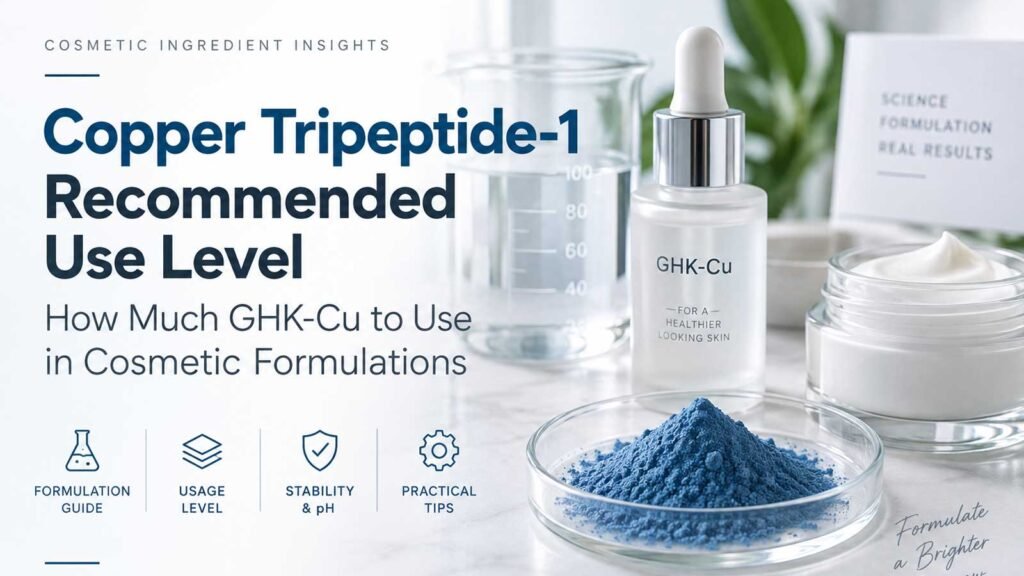
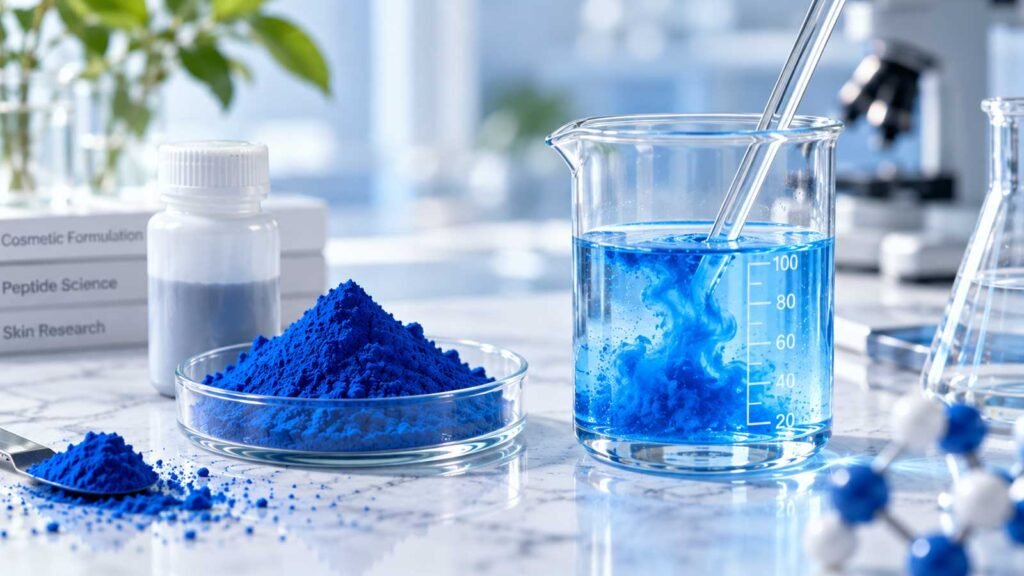
Copper Tripeptide-1 Recommended Use Level: How Much GHK-Cu to Use in Cosmetic Formulations

Copper Tripeptide-1 recommended use level is not simply a percentage copied from a supplier brochure. For a cosmetic formulator, the useful question is how much active GHK-Cu is actually being introduced into the finished product, and that depends on the form of the raw material, its assay, the formulation target, and the behavior of the […]
Copper Tripeptide-1 Recommended Use Level: How Much GHK-Cu to Use in Cosmetic Formulations Read More »

Copper Tripeptide-1 solubility and GHK-Cu powder dissolution

Copper Tripeptide-1 Solubility: How to Dissolve GHK-Cu Powder

Copper Tripeptide-1 solubility is more than a specification-sheet question. For a cosmetic formulator, the practical issue is whether GHK-Cu powder can be converted into a uniform aqueous phase and then incorporated into a finished formula without persistent particles, cloudiness, precipitation, or unnecessary processing stress. Copper Tripeptide-1, commonly referred to as GHK-Cu, is a copper complex

Copper Tripeptide-1 Solubility: How to Dissolve GHK-Cu Powder Read More »

Copper Tripeptide-1 powder vs solution comparison

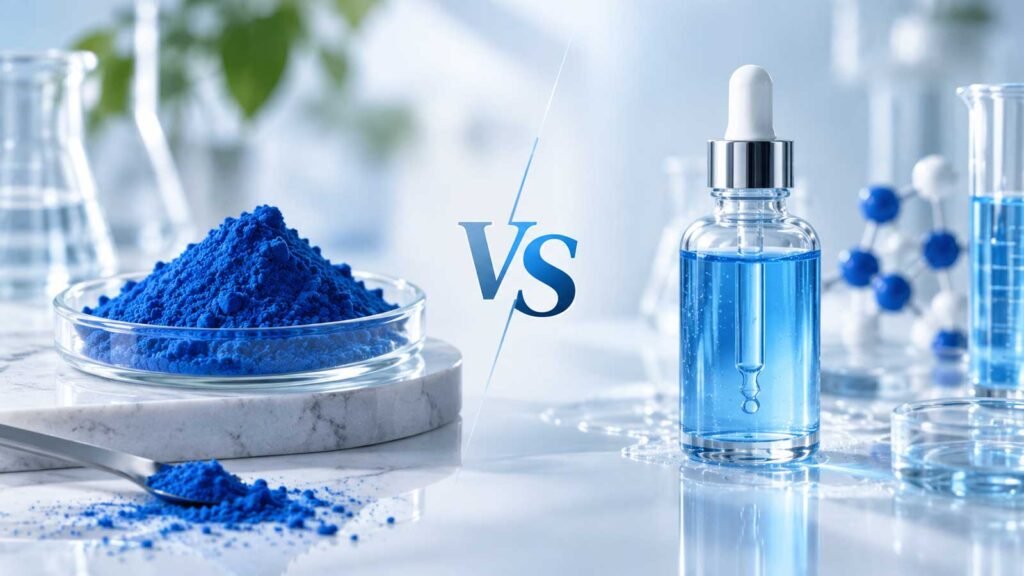
Copper Tripeptide-1 Powder vs Solution: Which Should Formulators Choose?

Copper Tripeptide-1 powder vs solution is not simply a choice between a dry and liquid version of the same cosmetic ingredient. For formulators and raw-material buyers, the format affects concentration control, processing, formulation flexibility, storage, documentation, freight, and the way commercial cost should be calculated. Copper Tripeptide-1 powder, commonly associated with GHK-Cu powder, is supplied as

Copper Tripeptide-1 Powder vs Solution: Which Should Formulators Choose? Read More »

Copper Tripeptide-1 vs GHK-Cu comparison for cosmetic ingredient buyers

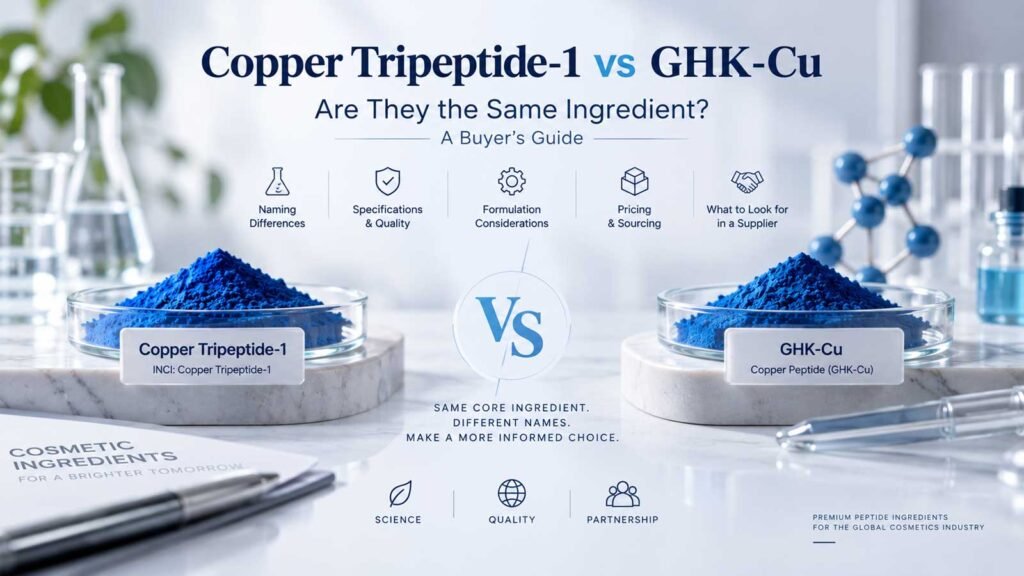
Copper Tripeptide-1 vs GHK-Cu: Are They the Same Ingredient? A Buyer’s Guide

Copper Tripeptide-1 vs GHK-Cu is a common point of confusion when cosmetic formulators and ingredient buyers compare technical documents from different peptide suppliers. One quotation may list Copper Tripeptide-1, another may describe the material as GHK-Cu powder, while a COA may use both names. In most cosmetic sourcing contexts, these terms refer to the copper complex

Copper Tripeptide-1 vs GHK-Cu: Are They the Same Ingredient? A Buyer’s Guide Read More »

PDRN vs Retinol: Key Differences in Skincare Formulations and Ingredient Selection

Introduction PDRN vs Retinol is becoming an increasingly important comparison for skincare brands, cosmetic formulators, and ingredient procurement teams evaluating advanced active ingredients for modern skincare formulations. Although both ingredients are widely discussed in the beauty industry, they represent two different categories of cosmetic raw materials with distinct molecular structures, sourcing considerations, and formulation strategies. The

PDRN vs Retinol: Key Differences in Skincare Formulations and Ingredient Selection Read More »

PDRN powder for skincare formulations used as regenerative cosmetic raw material

PDRN Powder for Regenerative Skincare Formulations: Manufacturing and Supplier Insights

Introduction The demand for pdrn powder for skincare has increased significantly as the global cosmetic and aesthetic industry continues to shift toward biologically active and scientifically driven ingredients. Among these, regenerative skincare ingredients derived from polynucleotide technology have gained strong attention from formulation developers, OEM manufacturers, and raw material distributors. As a specialized pdrn powder supplier, the

PDRN Powder for Regenerative Skincare Formulations: Manufacturing and Supplier Insights Read More »

Injectable-Grade-PDRN-Applications-Manufacturing-and-Supplier-Insights

Injectable Grade PDRN: Applications, Manufacturing and Supplier Insights

Introduction The demand for advanced bioactive ingredients in aesthetic formulations has increased significantly in recent years, particularly within the professional skincare, mesotherapy, and regenerative aesthetics sectors. Among these materials, injectable grade PDRN has become a key focus for formulators, brand owners, and procurement teams looking for high-performance raw materials with consistent quality and reliable supply chain

Injectable Grade PDRN: Applications, Manufacturing and Supplier Insights Read More »

PDRN-Supplier-in-China

PDRN Supplier in China: Manufacturing Standards and Buying Guide

Introduction As a professional PDRN supplier in China, the global supply of PDRN raw material has become increasingly important for aesthetic brands, OEM manufacturers, and skincare formulators seeking high-purity polynucleotide ingredients. In recent years, demand for advanced bioactive ingredients such as PDRN powder has expanded rapidly across the aesthetic and skincare industry. These materials are widely

PDRN Supplier in China: Manufacturing Standards and Buying Guide Read More »

Technical comparison between PDRN powder and PN ingredients

PDRN vs PN: Key Differences for Aesthetic and Skincare Formulations

Introduction As the global aesthetic and skincare industries continue to evolve, ingredient selection has become increasingly important for product developers, formulation teams, and procurement professionals. Among the most discussed categories in recent years are polynucleotide ingredients, particularly PDRN and PN, both of which are frequently associated with advanced aesthetic formulations and next-generation skincare concepts. Despite their

PDRN vs PN: Key Differences for Aesthetic and Skincare Formulations Read More »

What is PDRN powder derived from salmon DNA

What Is PDRN Powder and Why Is It Used in Aesthetic Formulations?

The rapid evolution of aesthetic formulations has created growing demand for bioactive ingredients that combine scientific credibility, formulation flexibility, and strong market appeal. Among the ingredients attracting significant attention from product developers, medical aesthetic brands, and skincare manufacturers, PDRN powder has emerged as one of the most discussed innovations in recent years. Derived from highly purified

What Is PDRN Powder and Why Is It Used in Aesthetic Formulations? Read More »

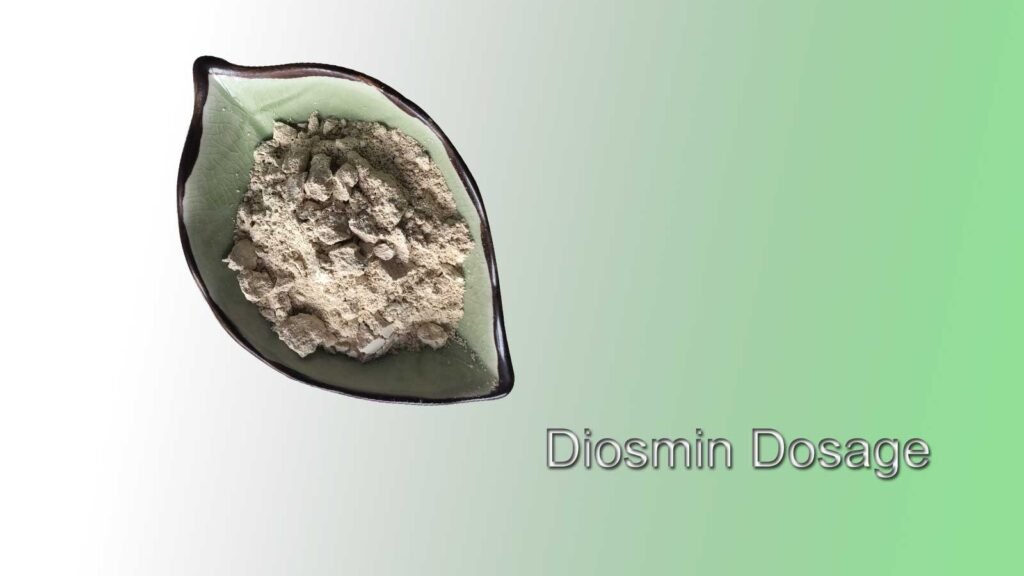
Diosmin Dosage: How to Use It Safely and Effectively

Diosmin is a natural flavonoid commonly used to support vein health, improve circulation, and relieve symptoms of conditions like varicose veins and hemorrhoids. This powerful antioxidant, derived from citrus fruits, has gained popularity in both prescription medications and over-the-counter supplements. However, understanding the correct Diosmin dosage is crucial for its effectiveness and safety. In this

Diosmin Dosage: How to Use It Safely and Effectively Read More »

Sodium Polyglutamate vs Glycerin comparison for moisturizers in skincare

Sodium Polyglutamate vs Glycerin: Which Moisturizer Works Better?

Sodium polyglutamate vs glycerin is very popular in global market. In the skincare industry, selecting the right ingredients is critical for achieving the desired effects in formulations. Moisturizers, in particular, are a cornerstone of most skincare routines, and their effectiveness is often determined by the ability to retain water and protect the skin’s natural moisture

Sodium Polyglutamate vs Glycerin: Which Moisturizer Works Better? Read More »

Shopping Cart

Quote Inquiry

Quote Inquiry