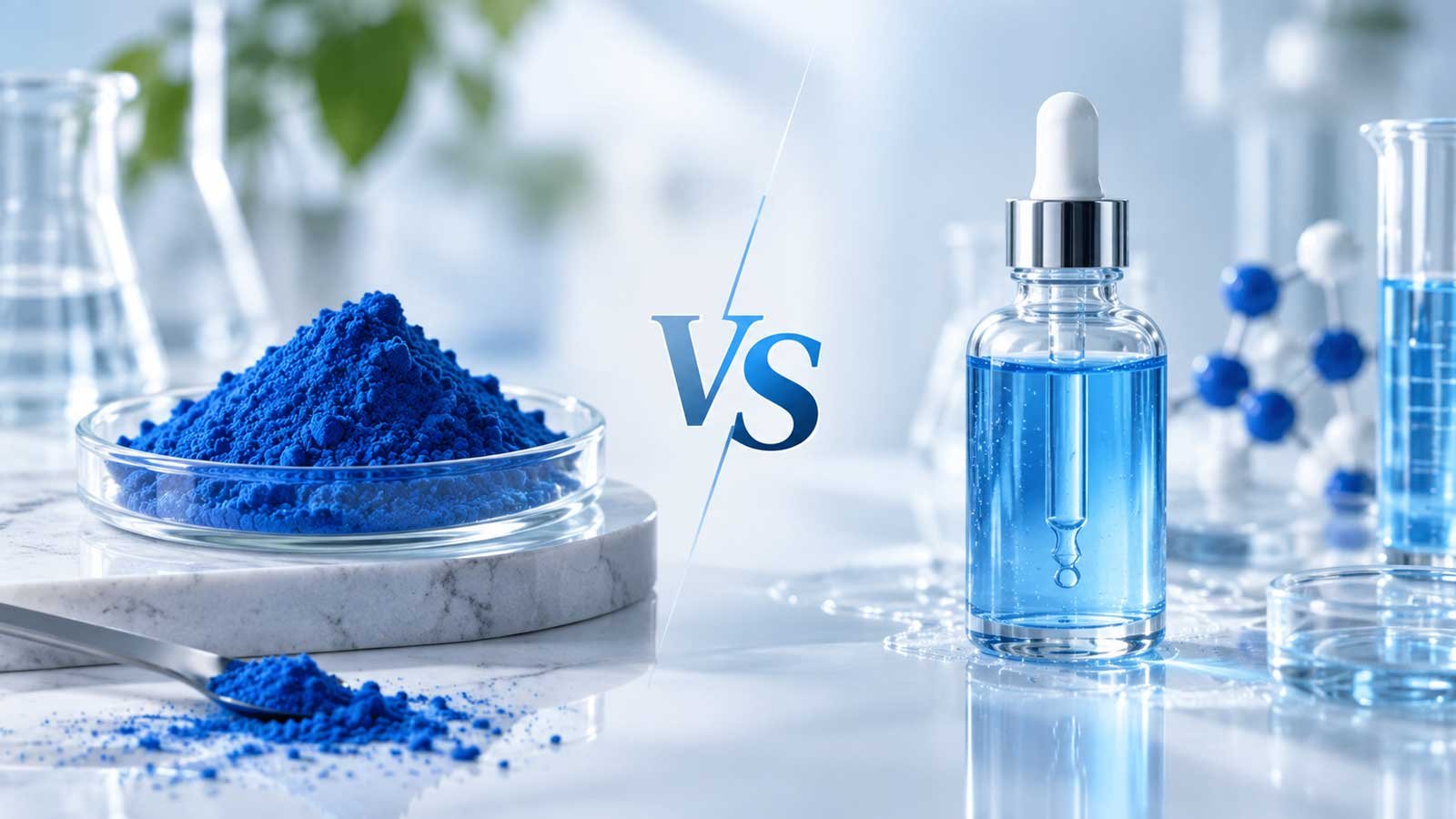
Copper Tripeptide-1 powder vs solution is not simply a choice between a dry and liquid version of the same cosmetic ingredient. For formulators and raw-material buyers, the format affects concentration control, processing, formulation flexibility, storage, documentation, freight, and the way commercial cost should be calculated. Copper Tripeptide-1 powder, commonly associated with GHK-Cu powder, is supplied as a concentrated peptide raw material that gives manufacturers control over dilution and the final formulation system. A premixed Copper Tripeptide-1 solution, by comparison, can reduce preparation steps but introduces a predefined concentration and carrier system that must be evaluated as part of the formula.
Neither format is universally better. The practical choice depends on the manufacturer’s formulation capability, batch size, processing method, quality requirements, and plans for commercial scale-up. This guide compares the two formats from a formulation and procurement perspective, with particular attention to the information buyers should verify before approving a raw material.
Copper Tripeptide-1 Powder vs Solution: The Quick Answer
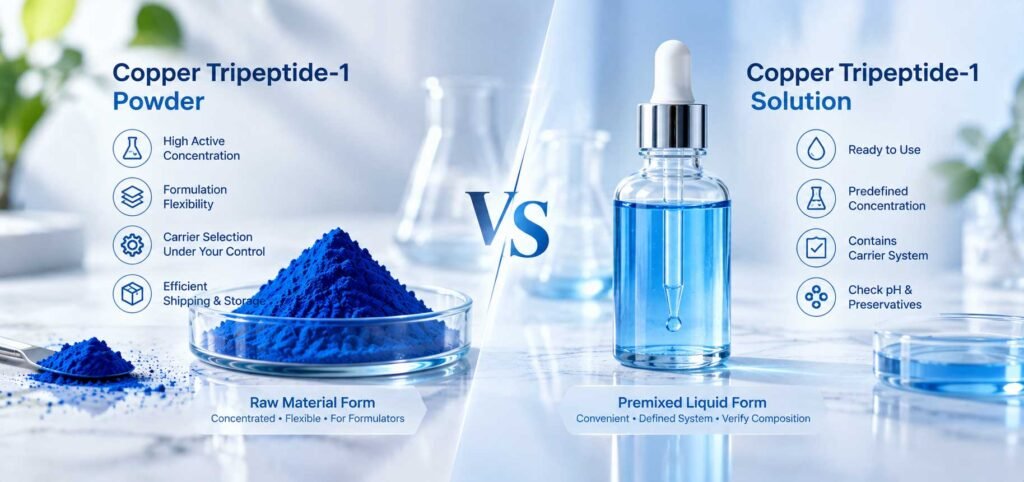
For manufacturers comparing GHK-Cu powder vs solution, powder generally offers greater flexibility over active concentration, carrier selection, formulation composition, and scale-up. It is often the more practical starting material when an experienced formulation team wants direct control over how Copper Tripeptide-1 enters the finished product.
A premixed solution can be convenient when reducing weighing and dissolution steps is important. However, the buyer needs more information than the percentage printed on the product label. The actual Copper Tripeptide-1 concentration, solvent or carrier system, pH, preservatives where applicable, storage conditions, and stability information all influence whether that liquid is suitable for a particular formula.
Therefore, when deciding between copper peptide powder vs liquid, the best format is the one whose composition and technical characteristics fit the manufacturing process—not simply the one that appears easier to use.
What Is Copper Tripeptide-1 Powder?
Copper Tripeptide-1 powder is the dry raw-material form of the copper-peptide complex commonly referred to as GHK-Cu. In cosmetic ingredient sourcing, it is typically supplied as a characteristic blue powder and is subsequently incorporated into a formulation according to the manufacturer’s process.
GHK-Cu Powder as a Concentrated Raw Material
The main purchasing advantage of GHK-Cu powder is that the formulator receives a concentrated raw material rather than a pre-diluted ingredient system. This provides greater freedom when determining the active concentration and selecting the other components that enter the finished formula.
For quality evaluation, buyers should review more than the appearance of a copper peptide powder. The specification should clearly define the relevant identity and quality parameters, while the COA should report the results for the batch being evaluated. Depending on the agreed specification, this may include assay or purity, moisture-related parameters, and applicable contaminant controls.
Powder also requires the manufacturer to establish an appropriate weighing and incorporation procedure. It should therefore be viewed as a formulation raw material rather than a ready-to-use cosmetic preparation.
What Is a Copper Tripeptide-1 Solution?
A Copper Tripeptide-1 solution is a liquid ingredient system in which Copper Tripeptide-1 is supplied at a defined concentration in a carrier. Depending on the manufacturer, the system may contain water and can also contain humectants, buffers, preservatives, or other formulation components. The exact composition must be confirmed from the supplier rather than assumed.
What Buyers Should Check in a Premixed GHK-Cu Solution
When evaluating a GHK-Cu solution, the first question should be: what percentage of actual Copper Tripeptide-1 does the material contain?
A product described as a “1% solution,” for example, needs a clear technical definition. Procurement and formulation teams should establish whether that number refers to actual Copper Tripeptide-1 content, a proprietary active blend, or another basis of calculation.
The complete composition of a copper peptide solution also matters because its carrier becomes part of the finished formulation. Formulators should therefore review the INCI composition, active concentration, pH, preservation system where applicable, storage conditions, and available stability information before substituting one liquid ingredient for another.
This is one reason quotations for liquid Copper Tripeptide-1 cannot be compared directly with powder quotations on a simple price-per-kilogram basis.
Copper Tripeptide-1 Powder vs Solution: Key Differences at a Glance
The practical differences become clearer when the two formats are compared according to formulation and procurement requirements.
| Buyer Consideration | Copper Tripeptide-1 Powder | Premixed Solution |
| Active concentration | Concentrated raw material | Defined by supplied dilution |
| Concentration flexibility | High | Limited by supplied concentration |
| Carrier selection | Controlled by formulator | Predetermined by supplier |
| Incorporation | Requires a controlled preparation step | Usually more convenient |
| Formulation control | Greater | Depends on complete solution composition |
| Shipping efficiency | Less carrier weight | Includes liquid carrier |
| Preservation | No premixed aqueous system | Must evaluate the liquid system |
| Storage | Follow powder specification | Depends on complete solution system |
| Documentation | Raw-material specification and COA | Requires active and solution composition data |
| Scale-up | Flexible for experienced manufacturers | Convenient where a fixed liquid input is preferred |
The central point in a Copper Tripeptide-1 powder vs liquid comparison is control. Powder gives the manufacturer greater control over what is added to the formula, while a premixed liquid transfers part of that formulation decision to the ingredient supplier.
Convenience can be valuable, but only when the composition behind that convenience is fully understood.
Concentration Control: Is Copper Tripeptide-1 Powder More Flexible?
Copper Tripeptide-1 concentration becomes particularly important when a formulation moves from laboratory development to pilot and commercial production.
With powder, the formulator can calculate the required amount from the supplied raw-material specification and establish an appropriate dilution or incorporation procedure. This flexibility can be useful when several finished products require different active levels or when the manufacturer wants to control the carrier system independently.
A premixed solution simplifies certain handling steps but introduces a dilution factor. If a manufacturer requires a given amount of active Copper Tripeptide-1, substantially more physical material may need to be handled when the purchased solution contains a low concentration.
This distinction also affects procurement calculations. A kilogram of concentrated GHK-Cu powder and a kilogram of diluted solution do not represent the same amount of active ingredient.
For commercial scale-up, buyers should therefore compare the actual active content entering each production batch rather than treating the gross weight of the two formats as equivalent.
Copper Tripeptide-1 Solubility and Incorporation: Powder vs Ready-to-Use Solution
Copper Tripeptide-1 solubility is one reason some formulators consider purchasing a premixed solution. A liquid format can eliminate the need to weigh and prepare the powder during each production run. However, convenience should not replace formulation validation.
When determining how to dissolve Copper Tripeptide-1 powder, formulators should consider the concentration being prepared, water quality, processing conditions, temperature, mixing procedure, and order of addition. The exact process should be established using the supplier’s technical information and validated within the intended formula.
A premixed liquid removes some of these preparation steps, but it does not remove compatibility considerations. Its carrier and other components still enter the finished product.
Similarly, GHK-Cu solubility data should be interpreted in the context of the material specification and actual formulation environment. A general statement that an ingredient is water compatible does not establish how it will behave at every concentration or in every cosmetic system.
For commercial production, reproducibility is more important than simply achieving dissolution once in a laboratory beaker.
Stability of Copper Tripeptide-1 Powder vs Solution
Copper Tripeptide-1 stability should not be reduced to a blanket statement that powder is stable and liquid is unstable. Stability depends on the material specification, packaging, environmental exposure, and storage conditions.
For powder, moisture exposure, temperature, light, packaging integrity, and storage duration should be controlled according to the supplier’s recommendations. Once the material is incorporated into a liquid system, additional variables become relevant.
Why Liquid Stability Requires More Information
A Copper Tripeptide-1 solution stability assessment may need to consider active concentration, pH, carrier composition, temperature, light exposure, preservation, packaging, and interactions with other components in the system.
This is why a buyer comparing GHK-Cu stability between powder and solution should ask what stability evidence is available for the actual commercial product rather than relying on assumptions about physical form.
The same principle applies to Copper Tripeptide-1 storage. Storage instructions for a dry raw material should not automatically be applied to a premixed liquid, and vice versa.
Finished-product manufacturers should perform their own stability testing after incorporation because raw-material stability data cannot substitute for validation of the complete cosmetic formulation.
Powder vs Solution Compatibility in Cosmetic Formulation
Buying a premixed solution does not automatically make Copper Tripeptide-1 compatibility easier to manage.
A liquid ingredient may introduce water, a humectant, buffer, preservative, electrolyte, or another carrier component into the finished system. Each component needs to be considered when the formula is being developed. This is particularly relevant for complex serums and emulsions containing multiple functional ingredients.
For GHK-Cu formulation compatibility, the more useful question is therefore not simply “Is this ingredient compatible?” but “Is this specific raw-material system compatible with the complete formula under the intended processing and storage conditions?”
Powder can give formulators more freedom to choose the surrounding system, while a solution may offer process convenience if its carrier is already compatible with the formulation.
In either case, a Copper Tripeptide-1 cosmetic formulation should undergo appropriate compatibility and stability assessment before commercial release.
Copper Tripeptide-1 Powder vs Solution Cost: How Buyers Should Compare Prices
A Copper Tripeptide-1 powder price cannot be compared directly with the price of a diluted liquid unless the actual active content is taken into account.
Suppose two quotations are presented per kilogram. The solution may appear substantially less expensive, but if only a fraction of that kilogram represents Copper Tripeptide-1, the relevant purchasing metric is the cost associated with the actual amount of active ingredient delivered.
This is why procurement teams should calculate active-equivalent cost before comparing a Copper Tripeptide-1 solution price with a powder quotation.
Other costs also matter. Powder may require weighing and preparation during manufacturing, while a ready-to-use solution may reduce labor at that stage. Conversely, a liquid system carries additional carrier weight, which can affect packaging, freight, storage space, and international transportation.
The same reasoning applies when comparing GHK-Cu powder price quotations from different suppliers. Specification and actual active content should be aligned first.
For commercial purchasing, price per kilogram is useful only after buyers establish what that kilogram actually contains.
Packaging, Shipping and Storage: Powder vs Liquid GHK-Cu
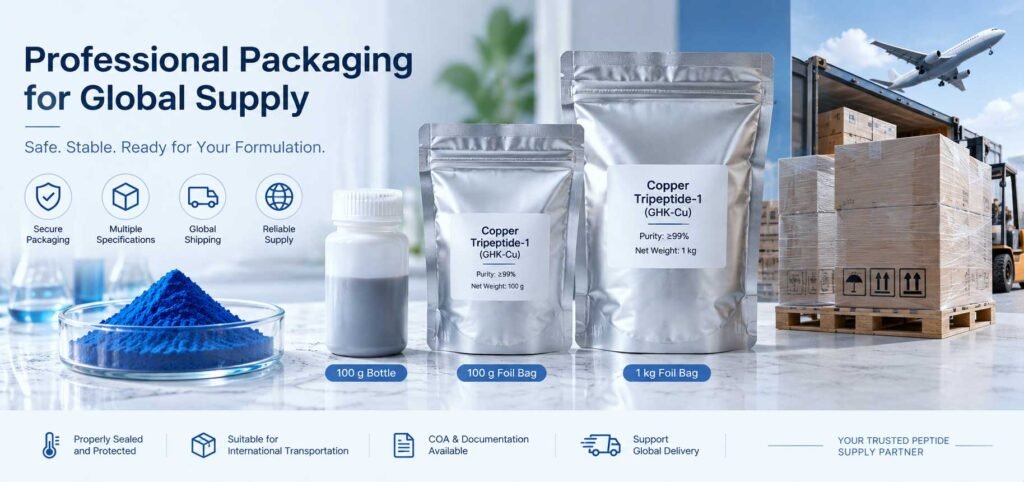
Physical form also influences logistics. Powder is compact and does not require the buyer to transport a large amount of carrier along with the active ingredient. This can become increasingly relevant as order volumes grow.
Appropriate GHK-Cu powder packaging should protect the material from environmental exposure during storage and transportation. CHEN LANG BIO TECH can supply Copper Tripeptide-1 powder in 10 g bottles, 100 g aluminum foil bags, and 1 kg aluminum foil bags, with commercial packaging arranged according to order requirements.
Liquid materials require packaging suitable for their carrier system and introduce additional considerations such as leakage prevention and greater gross shipping weight. Depending on the specific product, temperature and storage requirements may also differ.
For international Copper Tripeptide-1 shipping, buyers should therefore evaluate the complete logistics cost and storage requirements rather than considering ingredient price alone.
What Documents Should Buyers Request for Copper Tripeptide-1 Powder or Solution?
Documentation is one of the clearest areas where powder and liquid purchasing can differ.
For powder, buyers should normally review the current Copper Tripeptide-1 specification, a representative or batch-specific Copper Tripeptide-1 COA, SDS, technical information, and applicable storage guidance. The analytical method used for important quality parameters should also be understood when comparing suppliers.
For a solution, the same basic quality information is useful, but additional details become important. Buyers should establish the actual active concentration, complete ingredient composition, carrier system, pH where relevant, preservation approach, and available shelf-life or stability information.
A GHK-Cu COA that simply states the name of a proprietary liquid without making its active concentration clear provides limited value for technical comparison.
Documentation should allow procurement and R&D teams to answer three straightforward questions: What exactly is being purchased? How much Copper Tripeptide-1 does it contain? What specification will future batches be expected to meet?
Copper Tripeptide-1 Powder vs Solution: Which Is Better for R&D and Commercial Scale-Up?
The right choice changes with the manufacturing environment.
Small R&D Laboratories
A premixed solution can be practical for laboratories that work with very small batches and prioritize straightforward incorporation. However, researchers should still understand the active concentration and carrier composition before comparing results between materials.
Cosmetic and Contract Manufacturers
For experienced manufacturers, Copper Tripeptide-1 powder for cosmetic formulation can provide greater control over concentration, dilution, carrier selection, and process scale-up. It can also allow one raw material to support several formulations with different target concentrations.
This flexibility becomes more valuable when laboratory batches move into routine commercial manufacturing.
Ingredient Distributors
Distributors need to consider their downstream customer base. Some customers want a defined raw-material powder that their own formulation team can process, while smaller laboratories may prefer a prepared liquid system.
There is therefore no universal best Copper Tripeptide-1 for cosmetic formulation. The correct format is the one that matches the technical capabilities and production requirements of the customer using it.
How to Evaluate a Copper Tripeptide-1 Powder Supplier
When qualifying a Copper Tripeptide-1 powder supplier, buyers should look beyond a quoted purity figure or price per kilogram. Peptide synthesis, downstream purification, analytical testing, lyophilization, and scale-up capacity all influence whether the specification approved during development can be maintained when purchasing moves to commercial quantities.
Manufacturing, Purification and Analytical Capability Matter
CHEN LANG BIO TECH operates multiple large solid- and liquid-phase peptide reaction systems. Downstream processing is supported by six preparative liquid chromatography systems with columns of 150 mm and above and more than 20 semi-preparative chromatography systems.
Our analytical platform includes multiple Agilent and Waters HPLC instruments as well as mass spectrometry equipment. These capabilities support identity and quality evaluation during peptide development and production.
Rather than depending solely on external sourcing, our peptide platform combines synthesis and purification capabilities. For buyers evaluating a Copper Tripeptide-1 manufacturer or GHK-Cu manufacturer, this matters because purification capacity can become a practical bottleneck when a laboratory-scale project moves into larger production.
From Peptide Synthesis to Commercial-Scale Production
Our peptide synthesis platform supports sequences from 2 to 120 amino acids and cosmetic peptide projects with purity requirements reaching 99%, depending on the specific peptide and agreed specification. The platform has been developed for rapid, high-throughput synthesis and includes an extensive peptide product library accumulated through R&D and production work.
Annual production capacity for lyophilized peptides exceeds 100 kg. In addition to standard cosmetic peptide production, customized synthesis and various peptide modification services are available for universities, research institutions, and product-development projects.
This broader capability is relevant when evaluating a reliable copper peptide supplier because it demonstrates experience beyond a single catalogue item.
GMP-Controlled Purification, Lyophilization and Packaging
A 900 m² clean workshop is dedicated to peptide purification, preparation, lyophilization, and packaging under a quality system designed around GMP requirements. Operations follow defined SOPs, supported by a dedicated quality management team.
The company has also developed proprietary peptide separation and purification technology intended to improve downstream recovery and finished-product quality.
For buyers sourcing bulk Copper Tripeptide-1 powder, these capabilities matter because supplier qualification does not end when a small sample passes initial evaluation. The manufacturer must be able to reproduce the agreed specification through purification, analytical release, lyophilization, and packaging as purchasing volumes increase.
Current specification information, batch documentation, sample quantities, and commercial supply options can be provided according to project requirements.
Copper Tripeptide-1 Powder vs Solution: Final Selection Guide
The decision between powder and solution should follow the manufacturing process rather than a generic claim that one form is superior.
Choose powder when concentration flexibility, carrier control, formulation freedom, shipping efficiency, and commercial scale-up are priorities. Consider a premixed solution when ease of incorporation is more important and the supplier can clearly document its active concentration, complete composition, and stability.
For professional manufacturers, the key question is not which format has the lowest price per kilogram. It is which format provides the right combination of control, consistency, documentation, and process efficiency for the intended formulation.
CHEN LANG BIO TECH supplies Copper Tripeptide-1 powder for formulation development and commercial ingredient purchasing. For current specifications, COA availability, samples, packaging, or a quotation, contact us at extract@chenlangbio.com.
Frequently Asked Questions About Copper Tripeptide-1 Powder and Solution
Is Copper Tripeptide-1 available as both powder and solution?
Yes, the market includes Copper Tripeptide-1 powder and solution formats. However, liquid products can differ substantially in active concentration and carrier composition. Buyers should therefore review the complete specification rather than assuming that solutions from different suppliers are directly interchangeable.
Is Copper Tripeptide-1 powder water soluble?
When evaluating whether Copper Tripeptide-1 powder is water soluble, formulators should refer to the technical information for the specific material being purchased. Practical incorporation can be influenced by concentration, water quality, processing temperature, mixing conditions, and other ingredients in the formula.
Is GHK-Cu powder better than a premixed solution?
In a GHK-Cu powder vs solution comparison, neither format is universally better. Powder offers greater concentration and carrier control, while a well-documented premixed solution may simplify processing. The appropriate choice depends on formulation capability, production scale, and the composition of the supplied liquid.
How do you calculate Copper Tripeptide-1 concentration from a solution?
Start with the supplier’s declared actual active concentration rather than the commercial name of the blend. The amount of solution required should then be calculated according to the target Copper Tripeptide-1 level in the finished batch. If the active concentration is unclear, request clarification before formulation or purchasing.
Which form is easier to use in cosmetic formulation?
A premixed solution can reduce weighing and dissolution steps, making it convenient in some manufacturing environments. Powder, however, provides greater control over concentration and carrier selection. The better Copper Tripeptide-1 for cosmetic formulation therefore depends on the manufacturer’s process and technical capability.
Which form is better for commercial manufacturing?
Manufacturers that value concentration control and formulation flexibility may prefer powder, particularly when producing several formulations or scaling production. A liquid can be suitable where a fixed concentration and carrier system have already been validated and process convenience is the priority.
What documents should I request before buying GHK-Cu powder?
Before purchasing, review the GHK-Cu specification, COA, SDS, available technical information, storage requirements, packaging, and relevant analytical methods. For a liquid ingredient, also confirm actual Copper Tripeptide-1 concentration and the complete carrier or formulation system.
Where can I buy Copper Tripeptide-1 powder in bulk?
Companies looking to buy Copper Tripeptide-1 powder for cosmetic formulation, manufacturing, or ingredient distribution can source sample and commercial quantities from CHEN LANG BIO TECH. We support bulk Copper Tripeptide-1 powder purchasing with specification review, available batch documentation, multiple packaging formats, and international supply support.