Copper Tripeptide-1 for skin has attracted sustained interest in cosmetic science because the GHK-Cu complex has been studied in connection with extracellular-matrix activity, collagen-related processes, cellular signaling, oxidative-stress responses, and skin conditioning. Unlike many cosmetic peptides introduced primarily through finished-product marketing, GHK-Cu has a relatively long research history that gives formulators a useful scientific basis for understanding why it is used in modern skincare.
For cosmetic manufacturers, however, biological research is only part of the decision. A peptide that performs predictably in a controlled experimental system still has to be converted into a stable, reproducible cosmetic formulation. Concentration, purity, solubility, pH, processing conditions, compatibility, packaging, and batch consistency all become important once the ingredient moves from scientific literature to commercial manufacturing.
This guide therefore looks beyond a simple list of copper tripeptide-1 skin benefits. It examines what the research actually suggests, where the evidence has limitations, and what formulators and raw-material buyers should evaluate when selecting GHK-Cu for skincare development.
Copper Tripeptide-1 Skin Benefits: What the Research Suggests
Copper tripeptide-1 skin benefits are most appropriately discussed in relation to skin conditioning, extracellular-matrix processes, collagen-associated activity, cellular signaling, and research into oxidative-stress responses. Together, these areas help explain why GHK-Cu has become an established peptide of interest for age-care and premium skincare formulations.
The strength of evidence is not identical for every proposed benefit. Some observations come from biochemical or cell-based experiments, while others involve tissue models or human research. These study types answer different questions and should not be treated as interchangeable.
This distinction matters commercially. A raw-material supplier can use published science to explain the technical rationale for an ingredient, but a finished cosmetic product still needs appropriate formulation development and supporting evidence for the claims made about that specific product.
For R&D teams, the useful conclusion is therefore not that GHK-Cu guarantees a particular visible result. Rather, its research background provides a credible basis for considering the ingredient when developing formulations focused on skin condition, appearance, and age-care positioning.
What Is Copper Tripeptide-1 and Why Is It Called GHK-Cu?
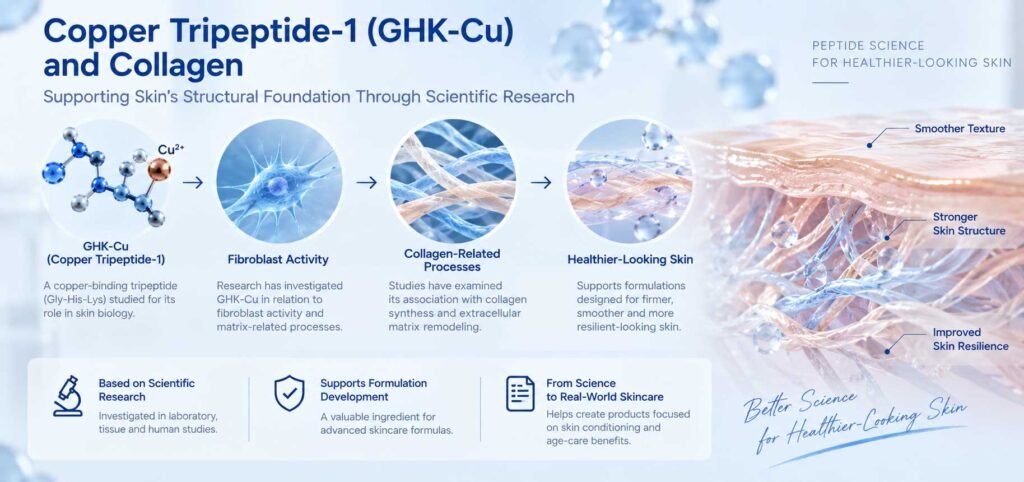
Copper Tripeptide-1, commonly referred to as GHK-Cu, is the copper complex associated with the tripeptide glycyl-L-histidyl-L-lysine. The abbreviation GHK comes from the three amino-acid residues Gly-His-Lys, while Cu denotes copper.
The histidine-containing sequence has copper-binding properties, and this coordination chemistry is fundamental to understanding the ingredient. Much of the scientific literature therefore uses GHK-Cu, whereas cosmetic specifications, ingredient lists, technical documentation, and commercial sourcing frequently use Copper Tripeptide-1.
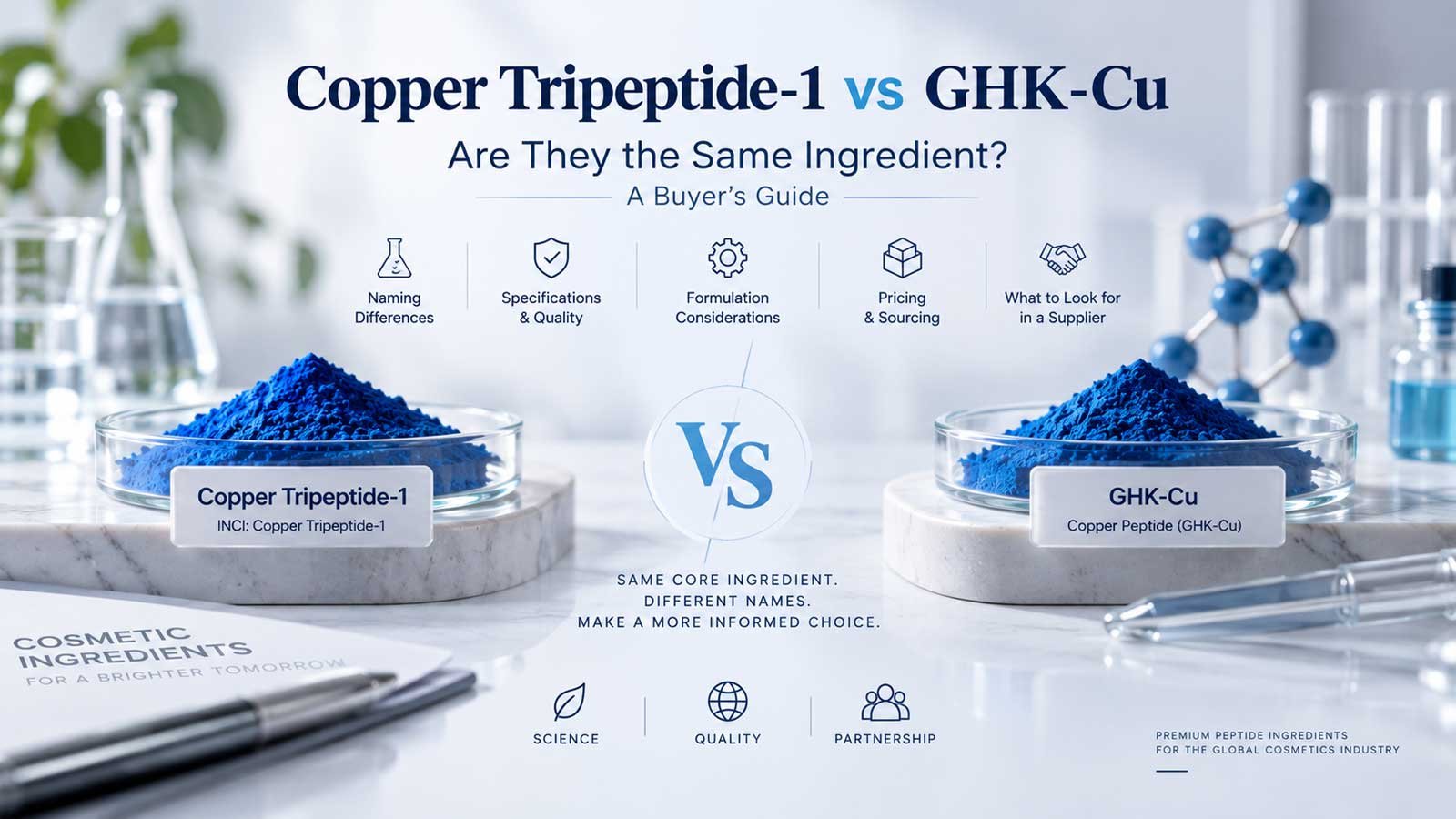
This naming difference explains much of the search interest around copper tripeptide-1 vs ghk-cu. In the relevant cosmetic context, they generally describe the same underlying copper-peptide complex rather than two unrelated skincare ingredients.
For procurement, however, equivalent naming does not mean equivalent commercial quality. Products from different sources may differ in specification, purity basis, analytical methods, physical form, moisture control, packaging, and batch consistency. Buyers should qualify the actual material and its documentation rather than approving a peptide based solely on the ingredient name.
How GHK-Cu Interacts With Skin-Related Biological Processes
GHK-Cu skin research extends across several areas of biological activity, which is one reason the peptide cannot be adequately described by a single marketing claim. Research has examined copper coordination, extracellular-matrix processes, cellular signaling, oxidative-stress pathways, and tissue-remodeling mechanisms.
Peptide Signaling and Copper Coordination
GHK has a strong ability to coordinate copper ions. This relationship is biologically relevant because copper participates in numerous enzyme systems and cellular processes, while the peptide provides a specific molecular environment for copper binding.
For formulators, the chemistry also explains why a generic “copper peptide” should not automatically be treated as equivalent to a characterized GHK-Cu raw material. Peptide sequence, identity, purity, and metal coordination all matter when defining the material being incorporated into a formulation.
Extracellular-Matrix Research
Copper peptide skin research has frequently examined processes involving the extracellular matrix, including collagen, elastin, glycosaminoglycans, and matrix remodeling.
The extracellular matrix forms an important structural environment within skin and is closely related to properties relevant to its appearance and mechanical characteristics. Research in this area therefore provides a reasonable scientific foundation for using GHK-Cu in cosmetic formulations developed around skin conditioning and mature-skin appearance.
The interpretation still needs restraint. Evidence that a molecule influences a particular pathway under experimental conditions does not establish that every cosmetic containing that molecule will reproduce the same biological response.
Cellular Signaling and Oxidative-Stress Research
GHK-Cu skin mechanisms have also been investigated in relation to cellular signaling, gene expression, oxidative stress, and other biological responses.
These findings expand the scientific rationale behind the ingredient, but they are best used to understand the molecule rather than to create exaggerated cosmetic claims. The finished formulation introduces variables that are absent from controlled laboratory experiments, including concentration, delivery environment, pH, other ingredients, storage, packaging, and consumer use conditions.
Copper Tripeptide-1 and Collagen: Interpreting the Evidence Correctly
Copper tripeptide-1 collagen research is one of the main reasons GHK-Cu appears frequently in discussions of age-care skincare. Experimental work has investigated the peptide in relation to fibroblast activity, collagen synthesis, extracellular-matrix components, and processes involved in matrix remodeling.
These observations are scientifically relevant, but the wording used to describe them matters.
What Laboratory Research Can Tell Us
Controlled experimental models allow researchers to examine specific cellular or biochemical responses at known concentrations and under defined conditions. They can therefore help identify mechanisms that would be difficult to isolate in a complete cosmetic formulation.
This makes GHK-Cu collagen research valuable when a formulator is evaluating the scientific rationale for including the ingredient.
It does not mean that an unspecified amount of GHK-Cu in any serum or cream will automatically produce the same result in human skin.
What It Means for Cosmetic Development
For formulators, the collagen-related literature supports the positioning of Copper Tripeptide-1 as an ingredient of interest in sophisticated skin-conditioning and age-care systems.
A responsible development process then moves from mechanism to formulation: confirm raw-material identity, define the intended active concentration, establish a suitable incorporation process, assess compatibility, and conduct appropriate finished-product stability and performance testing.
This approach preserves the value of the underlying science without turning mechanistic research into an unsupported product promise.
Copper Tripeptide-1 for Skin Appearance and Conditioning
Copper Tripeptide-1 for skin is particularly relevant to formulations designed around skin conditioning, smoother-looking texture, and the appearance of well-maintained mature skin. Serums, gels, emulsions, and premium peptide systems are common formulation formats in which this ingredient may be considered.
The technical rationale comes from the broader GHK-Cu research base rather than from a single claimed mechanism. Extracellular-matrix research, cellular signaling studies, and investigations involving collagen-related processes collectively explain why the peptide has remained of interest to cosmetic scientists.
For brands, however, ingredient science and finished-product claims should remain separate. Purchasing a high-quality GHK-Cu raw material does not by itself validate every claim that might appear on the final packaging.
A more defensible approach is to use ingredient-level evidence to explain why the peptide was selected, while relying on formulation-specific testing to support measurable product claims.
Is Copper Tripeptide-1 Relevant to Age-Care Formulations?
Copper tripeptide-1 anti-aging is a common search expression, although “anti-aging” itself covers a broad range of cosmetic objectives rather than a single scientifically measurable endpoint.
GHK-Cu is frequently considered for age-care formulations because its research background includes extracellular-matrix activity, collagen-related processes, skin conditioning, and cellular signaling. These areas are relevant when developing products intended to improve the appearance and condition of mature-looking skin.
From a regulatory and technical communication perspective, it is preferable to describe specific cosmetic objectives rather than suggest that a raw material can reverse biological aging.
This distinction is also useful for ingredient buyers. A supplier that can explain the evidence behind the ingredient without turning every mechanistic observation into a dramatic efficacy claim is generally providing more useful technical support to a professional formulation team.
Understanding GHK-Cu Research: Not All Evidence Means the Same Thing
GHK-Cu research includes biochemical experiments, cell studies, tissue models, animal research, human investigations, and work performed on finished formulations. Each contributes different information.
| Evidence Type | What It Helps Explain | Main Limitation |
| In vitro studies | Cellular and biochemical mechanisms | Do not reproduce complete human use |
| Ex vivo studies | Responses in isolated tissue | Lack the full biological environment |
| Animal studies | Biological mechanisms and responses | Cannot be directly converted into human cosmetic claims |
| Human studies | Outcomes under defined study conditions | Depend strongly on formulation and study design |
| Finished-product testing | Performance of the tested cosmetic | Primarily applies to that specific formulation |
This hierarchy becomes particularly important when reviewing copper tripeptide-1 studies used in supplier literature. A cellular experiment may provide strong mechanistic evidence without demonstrating the consumer-visible performance of a commercial serum.
Likewise, results obtained with one finished formulation cannot automatically validate another product simply because both contain GHK-Cu.
For procurement and R&D teams, a useful supplier question is therefore not simply, “Do you have studies?” A better question is: “What type of evidence supports this statement, and does it apply to the raw material or to a specific finished formulation?”
That distinction is valuable when assessing the technical credibility behind a commercial ingredient.
Copper Tripeptide-1 Concentration Matters as Much as Ingredient Selection
Copper tripeptide-1 concentration in skincare cannot be determined simply by reading the ingredient name. Raw materials sold as GHK-Cu may be supplied as concentrated powders, diluted powders, aqueous solutions, or formulated premixes.
This means that the percentage added during manufacturing and the actual concentration of Copper Tripeptide-1 in the finished formula can be very different numbers.
For example, adding 1% of a diluted commercial premix is not equivalent to adding 1% of a concentrated peptide powder. Procurement teams comparing supplier recommendations should therefore determine the active-content basis before comparing use levels or price.
The same principle applies to copper peptide recommended concentration. A percentage published for one commercial solution should not be transferred directly to a different powder specification.
Formulators should work from the specific supplier documentation, calculate the theoretical active input, and then validate the selected level in their own formulation.
Copper Tripeptide-1 Solubility, pH and Stability in Cosmetic Formulations
Copper tripeptide-1 solubility becomes particularly important when manufacturers work with concentrated powder rather than a ready-to-use liquid ingredient. GHK-Cu is characterized as a hydrophilic peptide complex, making aqueous formulation development practical, but successful incorporation still depends on concentration, water quality, mixing, and the surrounding formulation system.
Published preformulation research has also examined GHK-Cu under different pH and stress conditions. Such studies provide useful technical context, but controlled aqueous buffers should not be treated as identical to commercial cosmetic formulations containing humectants, preservatives, botanical extracts, electrolytes, surfactants, rheology modifiers, and other active ingredients.
GHK-Cu pH stability therefore needs to be considered in the complete formulation rather than in isolation.
Processing temperature, mixing time, and order of addition deserve the same attention. A robust copper tripeptide-1 formulation connects raw-material dissolution with pH control, ingredient compatibility, manufacturing conditions, packaging, and finished-product stability.
Copper Tripeptide-1 Powder vs Premixed Solution for Skincare Manufacturing
Copper tripeptide-1 powder gives experienced manufacturers direct control over active input and can reduce the amount of carrier material transported and stored. A premixed solution may offer simpler handling and dosing, particularly during early formulation development or small-scale manufacturing.
The decision should be based on manufacturing capability rather than assuming that one format is universally better.
| Factor | Concentrated Powder | Premixed Solution |
| Concentration control | Greater flexibility | Defined by premix strength |
| Calculation | Requires accurate weighing | Often easier to dose |
| Shipping | Less carrier weight | Includes liquid carrier |
| Incorporation | Controlled dissolution required | May simplify addition |
| Quality evaluation | Identity, assay and purity | Active level and carrier system |
For buyers comparing GHK-Cu powder with a solution, the commercial calculation should also be normalized to active content. A lower price per kilogram for a diluted material does not necessarily represent a lower cost per gram of Copper Tripeptide-1.
Why Copper Tripeptide-1 Raw-Material Quality Matters
High purity copper tripeptide-1 should be evaluated by more than a percentage displayed on a product page. Peptide quality begins with synthesis and continues through purification, analytical testing, lyophilization, packaging, storage, and batch release.
Identity and Specification
A current specification should clearly define what material is being supplied and the quality parameters agreed between buyer and manufacturer. An ambiguous “copper peptide” description is not sufficient for technical qualification.
HPLC and Analytical Control
Copper tripeptide-1 HPLC testing can provide valuable information about chromatographic purity when the method and reporting basis are understood.
A high HPLC result is useful, but buyers should not automatically interpret chromatographic purity as a complete description of active content, moisture, residual components, or every other characteristic of the raw material.
Batch Consistency
Commercial skincare manufacturing requires repeatability beyond the first sample. The material approved during R&D should be supported by manufacturing and quality systems capable of maintaining the agreed specification when the order moves from grams to commercial quantities.
That makes batch consistency a purchasing consideration rather than merely a laboratory issue.
What a Copper Tripeptide-1 COA Should Tell the Buyer
Copper tripeptide-1 COA documentation should allow the buyer to connect analytical results to a specific supplied batch.
Product identity, batch number, appearance, assay or purity information, analytical methods, and other agreed quality parameters should be reviewed against the current specification. Storage conditions and shelf-life or retest information should also be consistent with the broader technical documentation where applicable.
For peptide ingredients, understanding the basis of a purity result is particularly important. If a COA reports 99%, procurement should know whether that figure represents HPLC purity, assay, or another defined test.
A professional GHK-Cu COA therefore works together with the specification, TDS, SDS, and analytical documentation. It should not be treated as a generic certificate that replaces technical qualification.
From Peptide Synthesis to Commercial Copper Tripeptide-1
Copper tripeptide-1 manufacturer capability becomes especially important after an R&D sample has passed formulation testing. At that point, the buyer is no longer evaluating only whether a small quantity looks acceptable; the question becomes whether the approved quality can be reproduced at commercial scale.
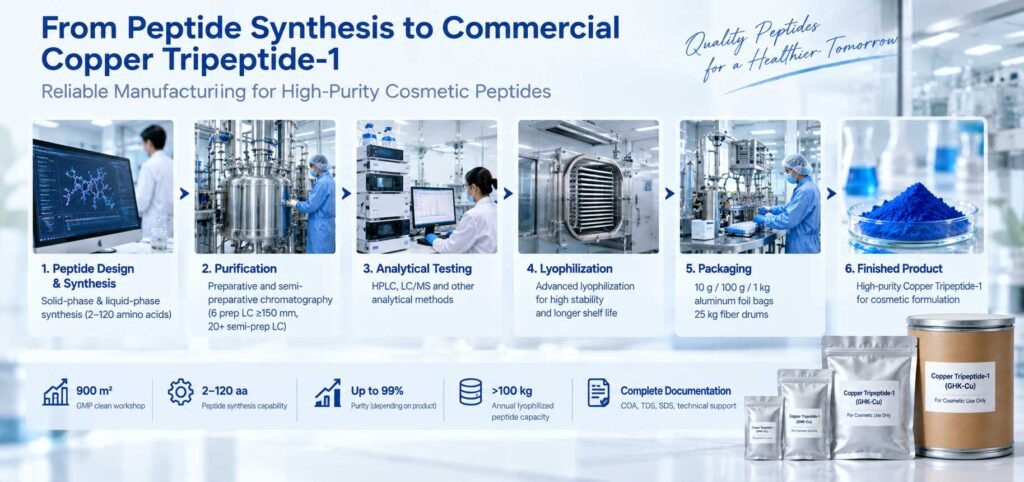
Our peptide platform combines solid- and liquid-phase synthesis with downstream purification, analytical testing, lyophilization, and controlled packaging. Synthesis capabilities cover peptides from 2 to 120 amino acids, providing a broader technical platform for cosmetic peptide development rather than a production line dedicated to a single material.
Purification is supported by six preparative liquid chromatography systems equipped with columns of 150 mm or larger and more than 20 semi-preparative chromatography systems. Multiple Agilent and Waters HPLC instruments, together with mass spectrometry, support analytical evaluation during development and quality control.
Peptide purification, preparation, lyophilization, and packaging are carried out in a 900 m² clean workshop designed around GMP requirements and SOP-controlled operations. Annual lyophilized peptide capacity exceeds 100 kg, while cosmetic peptide projects can achieve purity levels up to 99%, depending on peptide structure and the agreed specification.
For commercial buyers, the significance of this infrastructure is straightforward: synthesis, purification, analysis, lyophilization, documentation, and batch release need to function as one manufacturing system if the material qualified in development is to remain consistent during scale-up.
How to Evaluate a Copper Tripeptide-1 Supplier
Copper tripeptide-1 supplier qualification should begin with the technical specification rather than price. Buyers need to know exactly what is being offered, how its quality is defined, which analytical methods support the specification, and whether batch-specific documentation is available.
A current COA, TDS, SDS, storage information, and appropriate analytical documentation provide a stronger basis for evaluation than a product description alone.
An experienced GHK-Cu supplier should also be able to answer practical manufacturing questions. Can the material supplied for the commercial order meet the same approved specification as the evaluation sample? What packaging is available? How should the material be stored after opening? Can the supplier support sample quantities before scale-up? What analytical information can be supplied if the customer’s quality team requests it?
Price remains important, but it becomes meaningful only after the materials being compared have been technically normalized.
Buying Copper Tripeptide-1 Powder: From Evaluation Sample to Bulk Supply
Buy copper tripeptide-1 powder decisions are more reliable when technical qualification comes before commercial scale-up. For professional cosmetic manufacturers, the process normally begins with documentation review rather than a large first order.
A practical route is:
technical inquiry → specification review → COA review → sample evaluation → formulation trial → pilot validation → commercial approval
R&D can use the sample stage to evaluate dissolution, incorporation, compatibility, color, processing behavior, and finished-formula stability. Procurement can simultaneously assess documentation, packaging, lead time, logistics, and commercial terms.
Once the material is approved, bulk copper tripeptide-1 powder should be purchased against the agreed specification rather than simply against the same product name.
CHEN LANG BIO TECH supports R&D samples, formulation-development quantities, and commercial peptide supply. COA, specification, TDS, SDS, HPLC-related documentation, and additional technical information can be provided according to project requirements.
For current specifications, sample availability, or commercial pricing, contact extract@chenlangbio.com.
Key Takeaways for Formulators and Ingredient Buyers
Copper Tripeptide-1 for skin has a substantial scientific rationale built around research into extracellular-matrix processes, collagen-associated activity, cellular signaling, oxidative-stress responses, and skin conditioning. This body of research explains why GHK-Cu continues to be relevant to modern peptide-based skincare development.
Its scientific reputation does not remove the need for formulation discipline. Active concentration, purity, solubility, pH, compatibility, processing conditions, packaging, and finished-product stability determine how effectively the raw material can be translated into a commercial cosmetic.
For procurement teams, the same principle applies at supplier level: qualify the specification, analytical basis, documentation, batch consistency, and scale-up capability behind the ingredient rather than purchasing on a “copper peptide” label alone.
Frequently Asked Questions About Copper Tripeptide-1
What are the main Copper Tripeptide-1 skin benefits studied?
GHK-Cu skin benefits have been investigated in connection with extracellular-matrix activity, collagen-related processes, cellular signaling, oxidative-stress responses, and skin conditioning. The strength and relevance of evidence vary by study type, so laboratory findings should not automatically be presented as guaranteed finished-product effects.
Are Copper Tripeptide-1 and GHK-Cu the same ingredient?
Copper Tripeptide-1 vs GHK-Cu is primarily a naming distinction in the relevant cosmetic context. GHK-Cu is widely used in scientific and technical literature, while Copper Tripeptide-1 is commonly encountered in cosmetic ingredient documentation. Commercial specifications can still vary between suppliers.
What does research say about GHK-Cu and collagen?
GHK-Cu collagen research has examined fibroblast activity, collagen-related processes, and extracellular-matrix remodeling. These studies provide useful mechanistic support for cosmetic development, but they do not establish that every finished skincare product containing GHK-Cu will produce identical results.
Why is Copper Tripeptide-1 used in age-care skincare?
Copper tripeptide-1 anti-aging interest is largely connected with its research background in extracellular-matrix biology, collagen-associated processes, cellular signaling, and skin conditioning. For cosmetic claims, it is more appropriate to focus on appearance and conditioning objectives rather than suggesting reversal of biological aging.
How much Copper Tripeptide-1 should a formulation contain?
Copper tripeptide-1 concentration should be established from the actual raw-material specification. A concentrated powder and a diluted solution can require very different addition percentages. Formulators should calculate active input and validate the selected level in the complete product.
Is Copper Tripeptide-1 water soluble?
Copper tripeptide-1 solubility is compatible with aqueous formulation development because GHK-Cu is a hydrophilic peptide complex. Practical dissolution nevertheless depends on concentration, water quality, mixing, pH, and the composition of the formulation.
What should manufacturers check before purchasing GHK-Cu?
A professional buyer should review identity, specification, purity or assay basis, COA, analytical methods, TDS, SDS, storage, packaging, sample consistency, and commercial manufacturing capability before approving a GHK-Cu source.
Where can cosmetic manufacturers source Copper Tripeptide-1 powder?
Buy GHK-Cu powder projects should begin with supplier qualification and sample testing. Manufacturers should select a source capable of supporting the agreed specification with analytical documentation, consistent commercial production, appropriate packaging, and technical communication.
References
1. Pickart, L., Margolina, A. Regenerative and Protective Actions of the GHK-Cu Peptide in the Light of the New Gene Data. International Journal of Molecular Sciences. 2018;19(7):1987.
2. Pickart, L., Vasquez-Soltero, J.M., Margolina, A. GHK Peptide as a Natural Modulator of Multiple Cellular Pathways in Skin Regeneration. BioMed Research International. 2015.
3. Pickart, L., Vasquez-Soltero, J.M., Margolina, A. The Human Tripeptide GHK-Cu in Prevention of Oxidative Stress and Degenerative Conditions of Aging: Implications for Cognitive Health. Oxidative Medicine and Cellular Longevity. 2012.
4. Badenhorst, T., Svirskis, D., Wu, Z. Physicochemical Characterization of Native Glycyl-L-Histidyl-L-Lysine Tripeptide for Wound Healing and Anti-Aging: A Preformulation Study for Dermal Delivery. Pharmaceutical Development and Technology. 2016;21(2):152–160.
5. Cosmetic Ingredient Review Expert Panel. Safety Assessment of Tripeptide-1, Hexapeptide-12, Their Metal Salts and Fatty Acyl Derivatives, and Palmitoyl Tetrapeptide-7 as Used in Cosmetics. International Journal of Toxicology. 2018.