The copper tripeptide-1 recommended use level cannot be reduced to a single percentage without first defining the raw material. A concentrated GHK-Cu powder, a diluted powder blend, and a premixed Copper Tripeptide-1 solution may all appear under similar ingredient descriptions, yet adding 1% of each to a cosmetic batch can deliver very different amounts of the actual copper-peptide complex.
For formulators and purchasing teams, the more useful question is therefore not simply, “How much Copper Tripeptide-1 should we add?” It is: What is the active content of the material being purchased, how does the supplier define its recommended use level, and what concentration will that produce in the finished formulation?
This distinction becomes particularly important when comparing quotations from different peptide suppliers. Published safety assessments provide useful context on cosmetic use, while formulation research provides data on GHK-Cu stability and physicochemical behavior. Neither, however, replaces the specification, TDS, formulation testing, and stability validation required for a particular commercial raw material.
What Is the Recommended Use Level for Copper Tripeptide-1?
There is no technically meaningful universal copper tripeptide-1 recommended use level that can be applied to every commercial material sold under this name.
The correct starting level depends first on what is actually in the package. A high-concentration GHK-Cu powder and a supplier’s diluted aqueous solution should not carry the same formulation calculation simply because both use the INCI name Copper Tripeptide-1.
This is an important distinction because published numbers can otherwise be misleading. The Cosmetic Ingredient Review (CIR) safety assessment covering Copper Tripeptide-1 and related peptides reported typical use concentrations below 10 ppm for the peptide ingredients considered in its assessment and concluded that they were safe in the practices of use and concentration described in that review. That is valuable safety context, but it should not be read as a supplier-specific formulation recommendation for every GHK-Cu powder or premix sold today.
Likewise, commercial ingredient suppliers may recommend substantially higher percentages for a premixed raw material. Such percentages often refer to the total supplied ingredient rather than pure GHK-Cu active. This is why a formulator asking how much GHK-Cu to use should begin with the active-content basis, not the headline addition percentage.
Copper Tripeptide-1 Powder vs Solution: Why the Same Use Percentage Can Mean Different Things
A common source of confusion around GHK-Cu usage rate is the failure to distinguish the supplied raw-material format from the actual active concentration.
Concentrated GHK-Cu Powder
When working with a concentrated copper tripeptide-1 powder, the amount weighed into the formulation can be relatively close to the actual amount of peptide complex being introduced, depending on the agreed assay and specification.
The buyer should nevertheless confirm what the reported percentage means. A certificate showing a high chromatographic purity result does not automatically answer every question about active content, moisture, counterions, or the basis on which the material is sold.
For concentrated material, therefore, the GHK-Cu powder usage rate should be calculated against the actual specification rather than borrowed from a formulation guide written for a diluted commercial premix.
Diluted Copper Tripeptide-1 Solution or Premix
A copper tripeptide-1 solution concentration may be very different. A liquid commercial ingredient can include water, humectants, preservatives, buffers, or other carrier components depending on the supplier’s formulation.
If a supplier recommends adding 1% of such a material, that does not mean the finished cosmetic contains 1% pure GHK-Cu.
| Raw Material Form | What Buyers Should Confirm | Why It Matters |
| Concentrated powder | Assay and purity basis | Establishes actual peptide input |
| Diluted powder | Active percentage | Total powder weight may not equal GHK-Cu weight |
| Liquid solution | GHK-Cu concentration | Needed to calculate actual active level |
| Premix | Composition and active basis | Carrier system also enters the formula |
This is why procurement teams comparing copper tripeptide-1 powder vs solution concentration should normalize the offers to an active basis before comparing use levels or cost.
How to Calculate Copper Tripeptide-1 Active Concentration in a Cosmetic Formula
A simple calculation can eliminate much of the ambiguity surrounding how to calculate copper tripeptide-1 concentration.
For a raw material whose active content is expressed as a percentage:
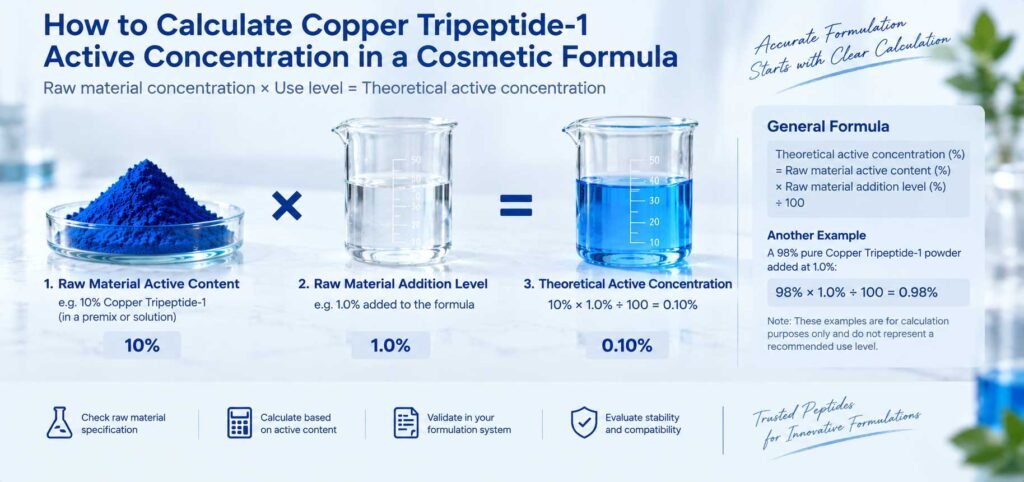
Theoretical active concentration in the finished formula (%) = raw-material active content (%) × raw-material addition level (%) ÷ 100
Consider a purely mathematical example.
Suppose a premixed ingredient contains 10% Copper Tripeptide-1 active and is added to a formulation at 1.0%.
The calculation is:
10 × 1.0 ÷ 100 = 0.10% theoretical active concentration
This example explains the calculation only. It is not a recommendation to formulate Copper Tripeptide-1 at 0.10%.
Now compare that with a hypothetical concentrated material containing 98% active added at the same 1.0% raw-material level:
98 × 1.0 ÷ 100 = 0.98% theoretical active concentration
The finished active input would therefore be almost ten times greater even though both formulation sheets say “1%.”
That difference is exactly why procurement teams should be cautious when comparing GHK-Cu recommended concentration figures across suppliers.
Why Purity and Active Content Are Not Always the Same Number
Another important distinction is between copper tripeptide-1 purity and assay or active content.
An HPLC purity result generally describes the relative chromatographic composition measured under a defined analytical method. It should not automatically be interpreted as a complete mass-balance statement for everything present in the raw material.
Similarly, an assay may be defined differently depending on the material and analytical method.
A professional specification should therefore make the test item, method, limit, and reporting basis clear. When a quotation says “GHK-Cu 99%,” a technically useful follow-up question is:
What analytical parameter does the 99% represent?
That question is more valuable than comparing percentage claims in isolation.
What Determines the Right GHK-Cu Concentration for a Formulation?
The right GHK-Cu concentration for cosmetic formulation is established through a combination of raw-material information and finished-product development rather than by choosing the largest percentage found online.
Product Format and Formulation System
An aqueous serum, gel, and emulsion do not provide identical environments for a peptide ingredient. Water content, rheology modifiers, electrolytes, surfactants, preservatives, and other actives can influence how a raw material is incorporated and how the formulation behaves over time.
Consequently, the same copper tripeptide-1 formulation concentration may require different processing strategies in different product systems.
Raw-Material Strength
The concentration of the supplied material must be known before the use level is selected. This is particularly important when a brand moves from a ready-to-use solution during early development to concentrated powder for commercial manufacturing.
The raw-material percentage may change dramatically even if the target active concentration remains the same.
Processing Conditions
pH, temperature, mixing time, order of addition, and holding time should be considered together with concentration. A formulation should not be scaled by adjusting ingredient weight while assuming that all processing conditions remain irrelevant.
Finished-Product Validation
A supplier recommendation is a useful development starting point, not a substitute for stability and compatibility testing in the customer’s actual formula.
That distinction is particularly important for contract manufacturers working across several bases with different compositions.
Does More Copper Tripeptide-1 Mean a Better Formula?
No. A higher copper tripeptide-1 usage rate does not automatically produce a better cosmetic formulation.
From a formulation perspective, increasing concentration can change raw-material cost, solution behavior, color intensity, compatibility requirements, and the margin available for other ingredients. The complete formula still needs to remain physically and chemically acceptable over its intended shelf life.
The published cosmetic safety literature should also not be converted into a marketing argument that “more is better.” CIR evaluated Copper Tripeptide-1 within reported cosmetic practices of use and concentration; its conclusion was a safety assessment, not an efficacy-based recommendation to maximize concentration.
For formulation teams asking how much GHK-Cu should be used, the defensible approach is to define a technically justified starting point from the specific raw-material documentation and then validate the complete product.
Copper Tripeptide-1 Solubility and Use Level: Why Concentration Changes Processing
Copper tripeptide-1 solubility becomes increasingly relevant when formulators move from a diluted premix to concentrated GHK-Cu powder.
Published preformulation work characterized GHK-Cu as highly hydrophilic, with log D values between −2.38 and −2.49 across pH 4.5–7.4. A more recent analytical study also cited reported aqueous solubility of 325.09 mg/mL. These data help explain why GHK-Cu can be handled in aqueous formulation work, but they should not be interpreted as permission to formulate at arbitrary concentrations.
As the target concentration changes, the formulator may need to reconsider dissolution time, mixing, preparation volume, and whether a copper tripeptide-1 stock solution is useful.
A concentrated powder should therefore be evaluated under the actual processing conditions intended for manufacturing rather than assuming that successful dissolution in a small laboratory beaker guarantees identical behavior at production scale.
pH, Temperature and Processing Conditions at Different Copper Tripeptide-1 Use Levels
Formulation concentration should not be considered independently of copper tripeptide-1 pH and processing conditions.
A published GHK-Cu preformulation study found the peptide stable in water and buffers between pH 4.5 and 7.4 for at least two weeks at 60°C under the study conditions. The researchers also observed greater susceptibility to degradation under basic and oxidative stress and, to a lesser extent, acidic stress.
These findings are useful for understanding GHK-Cu temperature stability, but they do not establish 60°C as a recommended manufacturing temperature or pH 4.5–7.4 as a universal commercial formulation specification.
A cosmetic product contains many components absent from a controlled buffer study. Increasing the peptide use level may also alter the formulation environment.
During development, record not only ingredient percentage but also pH, temperature history, mixing conditions, order of addition, and holding time. This creates a much stronger basis for transferring a successful bench formula to production.
How to Convert a Supplier’s Recommended Use Level Into Your Formula
A copper tripeptide-1 supplier recommended use level becomes useful only after the formulator understands what the supplier is recommending.
Start With the Supplier TDS
The TDS should identify, where applicable, the supplied form, active-content basis, recommended incorporation level, solubility or dispersion guidance, storage conditions, and relevant processing information.
If a document recommends “0.5–2%,” for example, ask whether that percentage refers to a concentrated peptide powder or a diluted commercial ingredient.
That is not a minor distinction.
Convert the Recommendation to an Active Basis
When evaluating two suppliers, calculate the theoretical amount of Copper Tripeptide-1 delivered by each material at the proposed use level.
This allows R&D and procurement to compare like with like.
It also improves price comparison. A lower price per kilogram for a heavily diluted solution may not represent a lower cost per gram of active GHK-Cu.
Confirm It in Your Own Formula
Once the calculation is understood, move through a controlled qualification process:
supplier recommendation → bench formulation → compatibility assessment → pilot batch → stability validation
A supplier’s TDS can guide development, but the finished-product manufacturer remains responsible for establishing that its own formulation and process perform as intended.
Reading a Copper Tripeptide-1 COA Before Setting the Use Level
A copper tripeptide-1 COA and TDS serve different purposes.
The TDS is generally the better place to look for formulation guidance. The COA is batch-specific evidence showing how a particular lot performed against agreed quality specifications.
For a GHK-Cu raw material, buyers should understand at least the following:
| COA Item | Question for the Buyer |
| Identity | Does the material correspond to the ordered ingredient? |
| Batch number | Can the result be traced to the supplied lot? |
| Appearance | Does the batch meet the agreed visual specification? |
| Assay/purity | What exactly does the reported percentage measure? |
| Analytical method | How was the result generated? |
| Other agreed tests | Does the batch meet the applicable specification? |
| Storage | How should the material be handled after receipt? |
When reviewing a GHK-Cu COA, procurement should resist comparing one headline purity number while ignoring the analytical basis.
The COA, specification, TDS, and formulation calculation should tell a consistent technical story.
From Bench Formula to Production: Scaling Copper Tripeptide-1 Use Level
A successful laboratory formula does not automatically become a robust copper tripeptide-1 commercial formulation simply by multiplying every ingredient weight.
At bench scale, formulators can closely observe powder addition, dissolution, color, pH, and mixing. Small quantities are also easier to weigh and manipulate under controlled conditions.
Pilot production introduces different vessel geometry, agitation, heat transfer, addition times, and holding periods. This is where the process should be challenged before full commercial manufacture.
At production scale, the manufacturer should have an established calculation method, defined order of addition, raw-material identification controls, processing parameters, and in-process acceptance criteria.
The intended active level may remain unchanged across these stages, but the process required to achieve consistent distribution can change substantially.
For this reason, commercial buyers should qualify both the ingredient and the manufacturing process.
Why Copper Tripeptide-1 Raw Material Quality Matters Before You Set the Formula
Selecting a high purity copper tripeptide-1 powder is not simply about finding the largest number printed on a specification sheet. Consistency depends on synthesis, purification, analytical control, lyophilization, packaging, and batch release working as a connected system.
This is where manufacturing infrastructure becomes relevant to formulation teams.
Our peptide platform includes multiple large solid- and liquid-phase peptide reaction systems. Downstream purification is supported by six preparative liquid chromatography systems with columns of 150 mm or larger and more than 20 semi-preparative chromatography systems. Analytical equipment includes multiple Agilent and Waters HPLC instruments together with mass spectrometry.
For a buyer evaluating copper tripeptide-1 HPLC results, access to analytical capability matters because commercial supply should be supported by more than a generic specification copied from one batch to another.
The broader synthesis platform supports peptides from 2 to 120 amino acids, while cosmetic peptide projects can reach purity levels up to 99%, depending on the peptide and agreed specification. Annual lyophilized peptide capacity exceeds 100 kg, and peptide purification, preparation, lyophilization, and packaging are supported by a 900 m² clean workshop designed around GMP requirements and SOP-controlled operations.
For commercial customers, the practical value is straightforward: the material evaluated during formulation development should be supported by a production and quality platform capable of maintaining the agreed specification when the project moves beyond a small sample.
What Should Buyers Request Before Purchasing Copper Tripeptide-1 Powder?
Before approving a copper tripeptide-1 powder supplier, procurement and R&D should align on what they actually need to evaluate.
A useful technical package normally begins with the current specification, representative or current-batch COA, TDS, SDS, storage information, packaging information, and relevant analytical documentation where available.
Rather than asking only:
“What is your recommended use level?”
a more useful technical question is:
“What is the concentration basis of the supplied material, and what does your recommended use percentage represent?”
For buyers evaluating a GHK-Cu supplier, this single question can reveal whether the quotation refers to concentrated powder, diluted material, or a formulated solution.
It also makes subsequent price comparisons considerably more meaningful.
Buying Copper Tripeptide-1 Powder: From Sample Evaluation to Bulk Supply
For companies planning to buy copper tripeptide-1 powder, sample qualification should establish the technical basis for the commercial order rather than functioning as a visual check alone.
A practical purchasing path is:
specification review → COA review → sample evaluation → formulation trial → pilot validation → commercial approval
CHEN LANG BIO TECH supports formulation-development samples as well as commercial quantities, with technical documents such as COA, TDS, SDS, specifications, and relevant analytical information available according to project requirements.
When a project progresses to bulk copper tripeptide-1 powder, buyers can confirm the approved specification, packaging requirements, quantity, destination, and documentation before production or shipment. This helps maintain continuity between the material qualified by R&D and the material subsequently purchased for manufacturing.
For current specifications, samples, or a commercial quotation, contact extract@chenlangbio.com.
Copper Tripeptide-1 Recommended Use Level: Final Formulation Takeaway
The correct copper tripeptide-1 recommended use level cannot be selected from a percentage alone.
First identify the raw-material form and active-content basis. Then calculate the theoretical active concentration delivered to the finished product and evaluate that level under the actual formulation and manufacturing conditions.
For development teams, the most useful sequence is:
raw-material identity → active concentration → use-level calculation → bench formulation → compatibility → pilot scale → stability validation → commercial approval
That approach makes supplier recommendations comparable and gives purchasing teams a much stronger technical basis for approving GHK-Cu raw materials.
Frequently Asked Questions About Copper Tripeptide-1 Use Level
What is the recommended use level for Copper Tripeptide-1?
The copper tripeptide-1 recommended use level depends on the concentration and form of the supplied raw material. Concentrated powder and diluted commercial solutions should not share a percentage simply because both are labeled Copper Tripeptide-1. Review the supplier’s active-content basis and TDS before establishing a starting formulation level.
How much GHK-Cu should I use in a cosmetic formula?
When determining how much GHK-Cu to use, calculate the actual amount of active delivered by the raw material rather than relying only on the total ingredient percentage. The appropriate level should then be validated in the intended formulation.
What is the recommended GHK-Cu concentration in cosmetics?
There is no single GHK-Cu recommended concentration applicable to every raw-material format and cosmetic system. Published cosmetic safety data and supplier recommendations provide useful context, but the commercial material’s concentration, formulation type, and finished-product validation determine the appropriate use level.
Is Copper Tripeptide-1 powder more concentrated than a solution?
A concentrated powder will generally deliver more GHK-Cu per gram than a diluted solution, but the exact comparison must come from the two product specifications. Never infer active concentration from physical form alone.
How do I calculate Copper Tripeptide-1 active concentration?
Multiply the raw material’s active percentage by its formulation addition percentage and divide by 100. For example, a hypothetical 10% active solution added at 1% would theoretically deliver 0.10% active. This is a mathematical illustration, not a recommended formulation level.
Can I increase the GHK-Cu use level for a stronger formula?
A higher GHK-Cu usage rate should not automatically be interpreted as a better formula. Increasing concentration can affect cost, formulation balance, compatibility, processing, and stability. Any change should be evaluated in the complete finished product.
Should I follow the supplier’s Copper Tripeptide-1 recommended use level?
Supplier guidance is a useful starting point when it clearly applies to the exact commercial material being purchased. Formulators should understand the concentration basis, follow relevant processing guidance, and validate the selected level in their own formulation rather than treating the supplier range as a universal rule.
Where can I buy Copper Tripeptide-1 powder for cosmetic formulation?
Companies looking to buy GHK-Cu powder can source material from peptide manufacturers capable of providing a defined specification, batch documentation, technical support, and commercial scale-up. CHEN LANG BIO TECH supplies Copper Tripeptide-1 powder for formulation-development and commercial projects; current documentation and quotation information can be requested at extract@chenlangbio.com.
References
1. Johnson W Jr., Bergfeld W.F., Belsito D.V., et al. Safety Assessment of Tripeptide-1, Hexapeptide-12, Their Metal Salts and Fatty Acyl Derivatives, and Palmitoyl Tetrapeptide-7 as Used in Cosmetics. International Journal of Toxicology. 2018. The assessment includes Copper Tripeptide-1 and reports typical peptide use concentrations below 10 ppm within the practices reviewed. Sage Journals
2. Badenhorst T., Svirskis D., Wu Z. Physicochemical characterization of native glycyl-L-histidyl-L-lysine tripeptide for wound healing and anti-aging: a preformulation study for dermal delivery. Pharmaceutical Development and Technology. 2016;21(2):152–160. The study reports GHK-Cu hydrophilicity, pH-related stability, stress degradation, and formulation compatibility data. Taylor & Francis Online
3. Quantitation of Copper Tripeptide in Cosmetics via Fabric Phase Sorptive Extraction Combined with Zwitterionic Hydrophilic Interaction Liquid Chromatography and UV/Vis Detection. Separations. 2024;11(10):293. Provides analytical and physicochemical context for GHK-Cu, including cited aqueous-solubility and log D data. MDPI
4. Cosmetic Ingredient Review Expert Panel. Safety Assessment of Tripeptide-1, Hexapeptide-12, Their Metal Salts and Fatty Acyl Derivatives, and Palmitoyl Tetrapeptide-7 as Used in Cosmetics. Final Report. Cosmetic Ingredient Review. 2014.