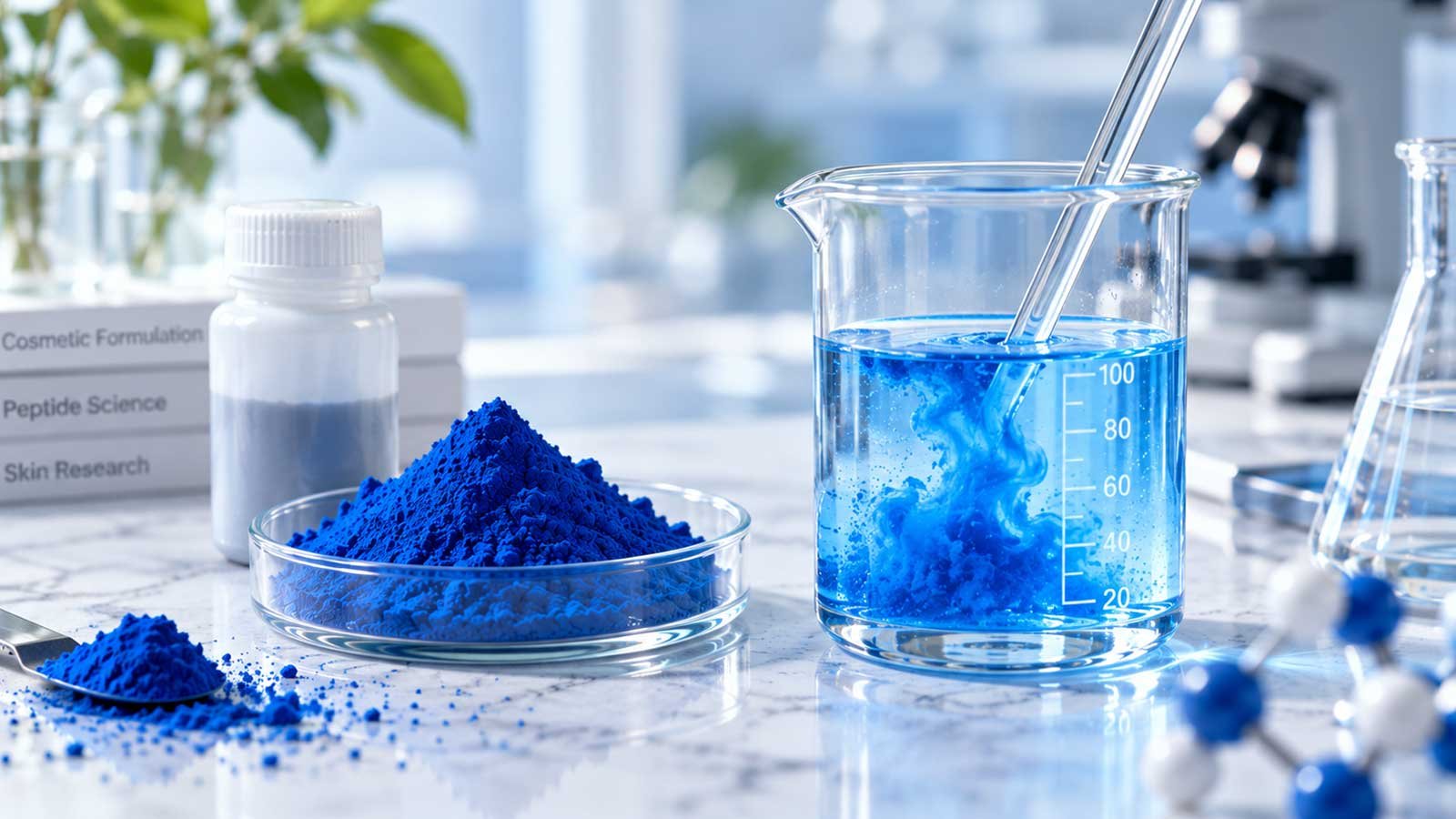
Copper Tripeptide-1 solubility is more than a specification-sheet question. For a cosmetic formulator, the practical issue is whether GHK-Cu powder can be converted into a uniform aqueous phase and then incorporated into a finished formula without persistent particles, cloudiness, precipitation, or unnecessary processing stress.
Copper Tripeptide-1, commonly referred to as GHK-Cu, is a copper complex of the tripeptide glycyl-L-histidyl-L-lysine. Published preformulation research characterizes GHK-Cu as highly hydrophilic: reported log D values ranged from −2.38 to −2.49 across pH 4.5–7.4. The same study found the material stable in water and in buffers within that pH range for at least two weeks at 60°C under the study conditions, while basic and oxidative stress produced greater degradation. These data are useful for understanding the ingredient, but they should not be converted into a universal manufacturing recipe for every commercial grade or cosmetic system.
For raw-material buyers, that distinction matters. Successful formulation depends not only on whether the peptide is described as water soluble, but also on material quality, concentration, water quality, mixing conditions, pH, processing sequence, and the composition of the finished product.
Is Copper Tripeptide-1 Water Soluble? The Quick Answer
Is Copper Tripeptide-1 water soluble? In practical cosmetic formulation, GHK-Cu is a highly hydrophilic copper-peptide material and is generally handled through an aqueous phase. Published physicochemical work supports its strong affinity for aqueous environments. However, “water soluble” should not be interpreted as “any concentration will dissolve immediately under any process conditions.”
This distinction explains why two formulators can work with the same ingredient name and still report different experiences.
Three concepts should be separated:
- Solubility describes whether and to what extent a material can form a solution under defined conditions.
- Dissolution rate describes how quickly the material reaches that state.
- Formulation compatibility describes what happens after the dissolved ingredient encounters the rest of the formulation.
Therefore, a clear laboratory solution is a useful first checkpoint, not proof that the peptide will remain compatible and stable throughout the shelf life of a serum, gel, emulsion, or other cosmetic product.
What Does Copper Tripeptide-1 Solubility Mean in Practice?
For buyers investigating Copper Tripeptide-1 solubility in water, a supplier statement such as “water soluble” provides only part of the information needed for formulation.
A more useful technical evaluation considers the conditions under which the raw material was tested and the conditions under which the customer plans to use it.
| Term | What It Tells a Formulator |
|---|---|
| Solubility | Whether the material can dissolve under defined conditions |
| Dissolution rate | How quickly the powder enters solution |
| Compatibility | How it behaves with the other components of the finished formula |
| Stability | Whether acceptable quality is maintained over time |
The distinction becomes particularly important for GHK-Cu dissolution. A powder may dissolve satisfactorily in purified water but behave differently after the resulting phase encounters a more complex system containing electrolytes, surfactants, polymers, preservatives, botanical extracts, or other functional ingredients.
Research on copper-peptide complexes also demonstrates that copper coordination chemistry can change with pH. Studies of different Cu(II)-peptide systems have identified pH-dependent coordination species, reinforcing why pH should be treated as a formulation variable rather than a minor processing detail. These studies are useful mechanistically, although data obtained with other peptide sequences should not be treated as a direct commercial specification for GHK-Cu.
What Affects GHK-Cu Powder Dissolution?
Several variables influence GHK-Cu powder dissolution, and they interact. Changing one factor without considering the others can make troubleshooting more difficult.
Water Quality and Copper Tripeptide-1 Solubility
For development work, controlled water quality improves reproducibility. Purified or otherwise appropriately controlled process water reduces uncertainty caused by variable mineral and ionic content.
This matters because Copper Tripeptide-1 is a metal-peptide complex. A formulator should avoid introducing uncontrolled variables and then attributing every change in appearance or dissolution to the peptide itself.
The same water specification used during successful laboratory development should therefore be considered when the formula moves to pilot and commercial production. A reproducible water system is more valuable than achieving a clear solution once with an undefined water source.
How Concentration Affects GHK-Cu Dissolution
Copper Tripeptide-1 concentration should be established before preparing the aqueous phase.
A dilute finished-product addition and a concentrated Copper Tripeptide-1 stock solution are not equivalent processing conditions. As concentration changes, dissolution time and the practical behavior of the system can also change. Consequently, formulators should not extrapolate indefinitely from a successful low-concentration laboratory test.
The required amount should be calculated from the actual raw-material specification and target formulation rather than from the visual intensity of the blue color.
Mixing Conditions and Dissolution Time
When determining how to mix GHK-Cu powder, stronger agitation should not automatically be regarded as better.
The objective is controlled, reproducible contact between powder and the aqueous phase. Adequate mixing time, appropriate addition rate, batch geometry, and concentration all matter. A process that works in a small laboratory vessel may require adjustment when transferred to a production tank because mixing dynamics change with scale.
For commercial manufacturing, the best procedure is one that can be repeated batch after batch.
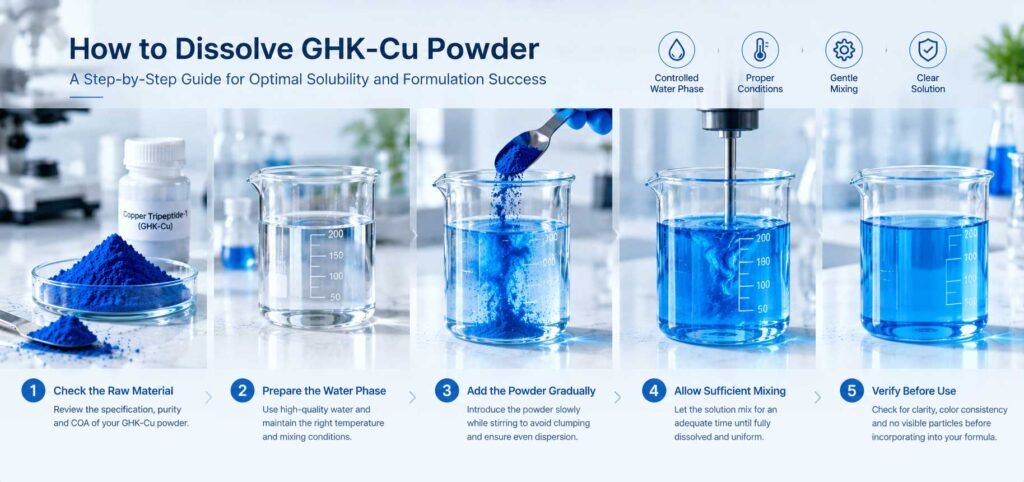
How to Dissolve GHK-Cu Powder: A Practical Formulation Workflow
There is no responsible universal recipe for how to dissolve GHK-Cu powder at every concentration and in every cosmetic system. A better approach is to establish a controlled workflow around the actual raw material and formulation.
Step 1: Review the Copper Tripeptide-1 Specification
Before opening the package, review the current Copper Tripeptide-1 specification and technical information.
Confirm ingredient identity, supplied form, relevant assay or purity information, storage conditions, and any manufacturer-specific handling guidance. When comparing materials from different sources, do not assume identical processing behavior solely because both are labeled Copper Tripeptide-1.
Step 2: Define the Target Concentration
Calculate the required raw-material amount from the batch size and target active level.
This is particularly important for GHK-Cu solution preparation because confusing raw-material purity, stock-solution concentration, and finished-product concentration can introduce significant dosing errors.
A pilot calculation should be documented so that the same basis is used during scale-up.
Step 3: Prepare the Appropriate Water Phase
Use water meeting the formulation’s established quality requirements and clean processing equipment. Establish the relevant temperature and mixing conditions before addition rather than adjusting several variables simultaneously after a problem appears.
This creates a controlled baseline for troubleshooting.
Step 4: Add the GHK-Cu Powder Under Controlled Mixing
When determining how to dissolve Copper Tripeptide-1 powder, gradual and controlled addition can help avoid local accumulation of dry material, particularly when preparing more concentrated intermediate phases.
Allow sufficient time for the material to enter solution before concluding that more aggressive processing is necessary. The appearance should be evaluated under consistent lighting and conditions.
Step 5: Verify Before Incorporation
Before transferring the prepared phase into the main batch, examine it for uniformity, persistent particles, unexpected cloudiness, precipitation, or unusual changes in appearance.
If the material does not behave as expected, changing temperature, pH, concentration, and mixing simultaneously makes root-cause analysis difficult. Change one relevant variable at a time and document the result.
That approach is far more useful for commercial scale-up than an informal “add and stir until clear” instruction.
Direct Addition vs GHK-Cu Stock Solution: Which Method Is Better?
A GHK-Cu stock solution can be useful when accurate dosing and uniform distribution are easier to achieve through a controlled intermediate phase. It may be particularly practical during laboratory development or where the amount of powder added to an individual batch is small.
Direct addition eliminates a separate preparation stage, but its suitability depends on the formulation, batch size, mixing equipment, and process sequence.
A stock solution introduces a different set of questions. The formulator must define its concentration, preparation method, storage conditions, allowable holding time, and microbiological or preservation strategy where relevant. A stock solution should therefore not be prepared and stored indefinitely simply because the dry raw material dissolves in water.
For routine manufacturing, the choice between direct addition and a Copper Tripeptide-1 stock solution should be based on validated process reproducibility rather than convenience alone.
Does Temperature Affect Copper Tripeptide-1 Solubility?
Temperature can affect dissolution processes, but increasing temperature should not be the automatic response when a peptide powder dissolves slowly.
Published preformulation research reported that GHK-Cu remained stable in water and pH 4.5–7.4 buffers for at least two weeks at 60°C under the specific experimental conditions. The same work found greater susceptibility under basic and oxidative stress. That is valuable stability information, but it does not mean every cosmetic formula containing GHK-Cu should be processed at 60°C.
A finished formulation contains many more variables than a controlled research solution.
When considering Copper Tripeptide-1 temperature during processing, the goal should be to establish a mild, reproducible procedure that achieves the required dissolution while remaining consistent with the raw-material supplier’s guidance and the stability requirements of the complete formula.
In other words, use heat because a validated process requires it—not simply because heat often accelerates dissolution.
How pH Affects GHK-Cu Solubility and Formulation Behavior
Copper Tripeptide-1 pH deserves careful consideration because GHK-Cu is a coordination complex rather than an inert blue colorant.
Research on copper-peptide chemistry shows that pH can alter protonation and copper coordination behavior. For example, studies of Cu(II)-tripeptide systems have observed different coordinated species as pH changes, while broader copper-peptide studies have used potentiometric and spectroscopic methods specifically to characterize this pH dependence.
For GHK-Cu itself, the preformulation study cited above found stability in water and buffers between pH 4.5 and 7.4 for the tested conditions, while basic stress increased hydrolytic degradation.
This does not establish a universal GHK-Cu pH stability range for every commercial cosmetic formula. It does show why pH should be controlled during development.
The finished formulation—not the peptide in isolation—ultimately needs stability validation.
When Should Copper Tripeptide-1 Be Added to a Cosmetic Formula?
The question of when to add Copper Tripeptide-1 to formulation cannot be answered responsibly with a single temperature or processing stage that applies to every product.
A formulator should consider the entire manufacturing sequence: water-phase preparation, heating and cooling history, mixing intensity, hold time, pH adjustment, addition of other actives, and subsequent homogenization or processing.
Where a separate GHK-Cu phase is prepared, adding it at a stage that limits unnecessary processing stress may be practical. However, the exact point should be determined during development and confirmed during pilot production.
This is especially important when scaling Copper Tripeptide-1 formulation from a beaker to a commercial vessel. A five-minute laboratory mixing step and the apparently equivalent operation in a production tank do not necessarily create identical conditions.
The process record should therefore define the order of addition and acceptance criteria, not merely the ingredient weight.
Why Is My GHK-Cu Solution Cloudy? Common Dissolution Problems
A GHK-Cu solution cloudy appearance is a troubleshooting signal, not a diagnosis. Several causes should be considered systematically.
Undissolved Blue Particles
If GHK-Cu powder is not dissolving completely, first review concentration, water quality, addition method, mixing time, and the condition of the stored raw material.
Persistent particles should not automatically be addressed by increasing heat or shear. Confirm that the material and process match the conditions previously validated.
Cloudiness After Initial Dissolution
If a phase appears clear initially and later becomes cloudy, determine what changed.
Was the pH adjusted? Was another raw material added? Did temperature change? Was the solution diluted with water of a different quality? Was it held for an extended period?
These questions usually provide more useful information than simply adding more solvent.
Precipitation After Addition to the Finished Formula
GHK-Cu precipitation after incorporation illustrates the difference between solubility and compatibility.
A material can dissolve successfully in an isolated aqueous phase yet encounter a very different chemical environment in the complete formulation. Electrolytes, polymers, surfactants, pH, and other ingredients can influence system behavior.
Troubleshooting should therefore compare the clear intermediate phase with the point in the manufacturing process at which precipitation first appears.
Unexpected Color Variation
Color is useful as an observation but should not be used as a substitute for analytical testing.
Differences in concentration, lighting, formulation matrix, raw-material specification, or batch characteristics can influence visual appearance. If a color change is accompanied by other unexpected behavior, review the batch documentation and formulation history before concluding that degradation has occurred.
Copper Tripeptide-1 Compatibility: Why Dissolution Is Only the First Step
Copper Tripeptide-1 compatibility becomes relevant as soon as the dissolved peptide meets the rest of the formula.
Serums, emulsions, gels, and other cosmetic systems can contain very different combinations of surfactants, thickeners, salts, preservatives, botanical extracts, and active ingredients. A successful water-solubility test does not demonstrate compatibility with all of them.
Published GHK-Cu preformulation research illustrates this point well. The investigators reported compatibility with Span 60-based niosomes but lower stability in the presence of negatively charged dicetyl phosphate. The finding is specific to the tested delivery systems, but it demonstrates why GHK-Cu formulation compatibility must be assessed in the actual formulation environment.
For commercial products, formulation compatibility and finished-product stability testing remain essential.
How to Store Copper Tripeptide-1 Powder Before Formulation
Correct Copper Tripeptide-1 storage begins with the supplier’s stated storage conditions.
Keep the material in properly sealed packaging and limit unnecessary exposure to moisture, light, and uncontrolled environmental conditions. Repeated opening should also be managed carefully, particularly when a larger commercial package is used for multiple production batches.
For GHK-Cu powder storage, record package opening and handling according to the manufacturer’s internal raw-material procedures. If production requires frequent small quantities, suitable pack sizes can reduce repeated exposure of the remaining material.
Do not automatically apply dry-powder storage conditions to a prepared aqueous stock. Once water is introduced, the system has different stability and microbiological considerations.
What Should Formulators Check on a Copper Tripeptide-1 COA and Specification?
A Copper Tripeptide-1 COA should help the technical team determine whether the received batch conforms to the agreed specification. It should not be treated as a decorative sales document.
Depending on the agreed material specification, useful information can include:
| COA / Specification Item | Why It Matters |
|---|---|
| Ingredient identity | Confirms what was supplied |
| Batch/lot number | Enables traceability |
| Appearance | Provides a basic incoming-quality reference |
| Assay/purity | Supports material qualification |
| Analytical method | Helps interpret the reported result |
| Moisture-related parameter | Relevant to dry material consistency where specified |
| Contaminant controls | Confirms applicable quality limits |
| Storage information | Supports warehouse handling |
When reviewing a GHK-Cu COA, buyers should also distinguish analytical purity from other ways a supplier may describe peptide content. Percentages from different suppliers are not necessarily comparable unless the underlying methods and specification basis are understood.
If two materials show different dissolution behavior, first confirm that their identity, specification, analytical basis, and storage history are genuinely comparable.
Can Raw Material Quality Affect GHK-Cu Dissolution Consistency?
Raw-material consistency matters because a formulation process is only as reproducible as its inputs.
A high purity GHK-Cu powder still needs controlled synthesis, downstream purification, analytical release, lyophilization, packaging, and storage. For procurement teams, a specification number becomes more meaningful when the supplier can explain how it is produced and verified.
Peptide Purification and Batch Consistency
CHEN LANG BIO TECH operates multiple large-scale solid- and liquid-phase peptide reaction systems. Our downstream platform includes six preparative liquid chromatography systems equipped with columns of 150 mm or larger and more than 20 semi-preparative chromatography systems. Analytical capabilities include multiple Agilent and Waters HPLC instruments and mass spectrometry.
These capabilities allow peptide synthesis, purification, and Copper Tripeptide-1 HPLC quality evaluation to be managed within an established peptide-production platform rather than treating the ingredient as a simple traded powder.
Manufacturing Capability Behind Copper Tripeptide-1 Powder
Our synthesis platform supports peptides ranging from 2 to 120 amino acids. Cosmetic peptide projects can be produced to purity levels up to 99%, depending on the peptide and agreed specification, while annual lyophilized peptide production capacity exceeds 100 kg.
Production is supported by a 900 m² clean workshop for peptide purification, preparation, lyophilization, and packaging, operated within a quality system designed around GMP requirements and defined SOPs. Proprietary peptide separation and purification technology is also used to improve downstream recovery and finished-product quality.
For buyers qualifying a Copper Tripeptide-1 manufacturer, these capabilities are more informative than a supplier simply claiming to offer “high purity.” They show whether the organization has the synthesis, purification, analytical, and scale-up infrastructure needed to support commercial batches.
Sourcing GHK-Cu Powder for Formulation Development and Commercial Production
When requesting a quotation from a Copper Tripeptide-1 powder supplier, provide enough information for the supplier to understand the project: required specification, quantity, sample needs, preferred packaging, destination country, and documentation requirements.
This avoids a common purchasing problem in which quotations are compared before buyers establish whether the offered materials are technically equivalent.
For customers looking to buy GHK-Cu powder, CHEN LANG BIO TECH supports samples, formulation-development quantities, and commercial supply. Available documentation can include COA, SDS, specifications, and related technical information according to the project.
Customers moving from laboratory evaluation to bulk Copper Tripeptide-1 powder can also discuss packaging and production requirements before scale-up. The objective is to keep the approved material specification consistent as purchasing moves from sample qualification into commercial production.
For current specifications, batch documentation, sample availability, or commercial quotation, contact admin@chenlangbio.com.
Copper Tripeptide-1 Solubility: Final Formulation Takeaway
Reliable Copper Tripeptide-1 solubility is not controlled by one variable. Formulators need to consider the supplied powder, target concentration, water quality, mixing conditions, temperature, pH, processing sequence, and the chemical environment of the finished formula.
A practical development sequence is:
Specification → concentration calculation → controlled water phase → powder addition → dissolution assessment → formulation incorporation → compatibility and stability validation
Most importantly, do not compensate for an unexplained dissolution problem by changing several processing conditions simultaneously. A controlled, documented process makes both troubleshooting and commercial scale-up considerably easier.
Frequently Asked Questions About Copper Tripeptide-1 Solubility
Is Copper Tripeptide-1 soluble in water?
Copper Tripeptide-1 is soluble in water in the practical sense that GHK-Cu is a highly hydrophilic peptide complex used in aqueous formulation work. Published preformulation research reported log D values of −2.38 to −2.49 between pH 4.5 and 7.4, supporting its strongly hydrophilic character. Actual dissolution behavior still depends on concentration and processing conditions.
Is GHK-Cu powder water soluble?
Yes, GHK-Cu powder water solubility supports preparation in an aqueous phase. However, buyers should distinguish water solubility from unlimited solubility or immediate dissolution. The commercial material, target concentration, water quality, temperature, and mixing procedure should all be considered.
How do you dissolve Copper Tripeptide-1 powder?
When determining how to dissolve Copper Tripeptide-1 powder, first review the supplier specification, calculate the required concentration, prepare a controlled aqueous phase, introduce the powder under appropriate mixing, allow sufficient dissolution time, and inspect the phase before incorporating it into the complete formula.
Should GHK-Cu powder be heated to dissolve it?
Heat should not be treated as an automatic requirement. Published research provides useful stability data under specific experimental conditions, but those results do not establish a universal manufacturing temperature. Use processing conditions appropriate to the supplied raw material and validate them in the finished formulation.
Can I make a GHK-Cu stock solution?
A GHK-Cu stock solution can be useful for controlled dosing and laboratory formulation. Its concentration, preparation procedure, storage conditions, holding time, and microbiological considerations should be defined rather than assuming that a prepared aqueous stock can be stored indefinitely.
Why is my GHK-Cu solution cloudy?
If a GHK-Cu solution is cloudy, check concentration, water quality, mixing, pH, temperature, and any ingredients added immediately before the change occurred. If cloudiness develops only after incorporation into the finished formula, investigate formulation compatibility rather than solubility alone.
Does pH affect Copper Tripeptide-1 solubility?
pH can influence copper-peptide coordination and formulation behavior. Published GHK-Cu preformulation work reported stability in tested buffers from pH 4.5 to 7.4, while basic stress increased degradation. Those findings are useful scientific evidence, but they should not be interpreted as a universal finished-product pH specification.
Where can I buy GHK-Cu powder for cosmetic formulation?
Buyers looking to buy Copper Tripeptide-1 powder for cosmetic R&D or commercial manufacturing can request specifications, available batch documentation, samples, packaging information, and a current quotation from CHEN LANG BIO TECH. Commercial GHK-Cu powder supplier support is available for projects progressing from formulation evaluation to larger-volume purchasing.
References
- Pickart L, Vasquez-Soltero JM, Margolina A. Physicochemical characterization of native glycyl-L-histidyl-L-lysine tripeptide for wound healing and anti-aging: a preformulation study for dermal delivery. The study reports hydrophilicity, stress stability, pH-buffer stability, HPLC/MS degradation analysis, and carrier compatibility relevant to GHK-Cu formulation.
- Cosmetic Ingredient Review Expert Panel. Safety Assessment of Tripeptide-1, Hexapeptide-12, their Metal Salts and Fatty Acyl Derivatives, and Palmitoyl Tetrapeptide-7 as Used in Cosmetics. Final Report, 2014. Copper Tripeptide-1 is included among the assessed metal-salt peptide ingredients.
- Brasun J, Gabbiani C, Ginanneschi M, Messori L, Orfei M, Swiatek-Kozlowska J. The copper(II) binding properties of the cyclic peptide c(HGHK). Journal of Inorganic Biochemistry. 2004;98(12):2016–2021. Used here as supporting evidence for the pH-dependent coordination behavior of copper-peptide systems, not as a direct GHK-Cu commercial specification.
- Copper(II)–tripeptide complexes in aqueous solution: Effects of the C-terminal chelate ring size on the coordination structure of doubly deprotonated complex species. Journal of Inorganic Biochemistry. 1999;77(3–4):147–155. Provides supporting evidence that Cu(II)-tripeptide coordination structure and species distribution can vary with protonation/pH conditions.