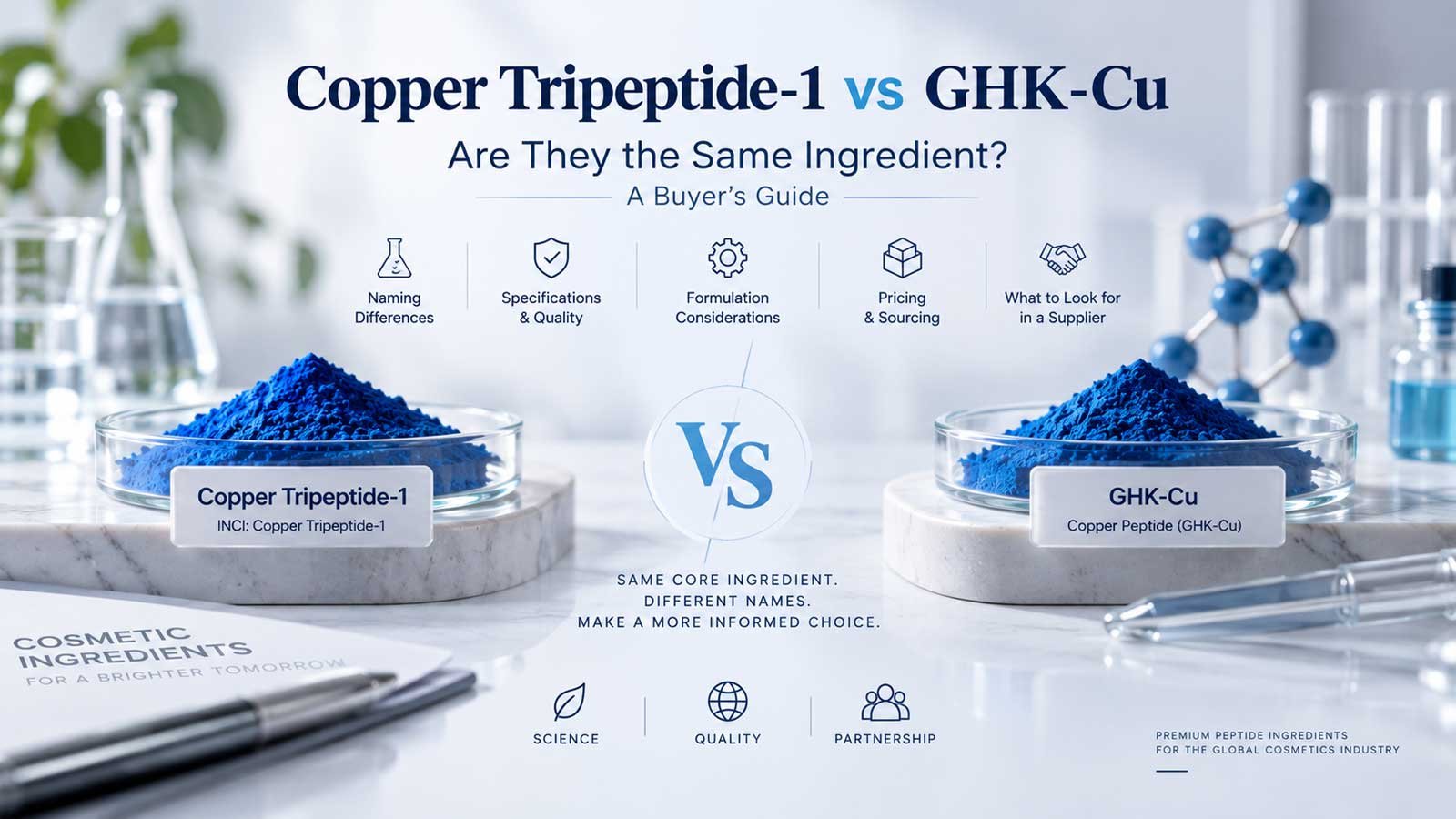
Copper Tripeptide-1 vs GHK-Cu is a common point of confusion when cosmetic formulators and ingredient buyers compare technical documents from different peptide suppliers. One quotation may list Copper Tripeptide-1, another may describe the material as GHK-Cu powder, while a COA may use both names. In most cosmetic sourcing contexts, these terms refer to the copper complex of the tripeptide GHK. However, that does not mean powders offered by different manufacturers are automatically equivalent in purity, composition, analytical results, or suitability for a particular formulation.
For procurement teams, the practical question is therefore not simply whether the names describe the same ingredient. Buyers need to establish whether the material behind each name meets the same identity and quality requirements. Comparing the specification, analytical method, batch COA, physical form, packaging, and supplier manufacturing capabilities provides a much more reliable basis for qualification than comparing product names or price alone.
This guide explains those differences from a raw-material purchasing perspective and provides a practical framework for evaluating Copper Tripeptide-1 before sample approval or commercial purchasing.
Copper Tripeptide-1 vs GHK-Cu: The Quick Answer
For buyers asking is Copper Tripeptide-1 the same as GHK-Cu, the short answer is that the names are commonly used for the same copper-peptide ingredient identity, but in different contexts. Copper Tripeptide-1 is the INCI terminology encountered in cosmetics, while GHK-Cu is widely used in scientific, technical, and commercial discussions to describe the copper complex formed with the GHK tripeptide.
The difference between Copper Tripeptide-1 and GHK-Cu is therefore primarily one of nomenclature rather than a reason to assume two fundamentally different cosmetic ingredients.
There is an important procurement qualification to that answer. Two suppliers can both offer a material described as Copper Tripeptide-1 or GHK-Cu while providing different specifications, analytical methods, moisture limits, packaging, or quality documentation. A purchasing decision should consequently be based on the actual material specification and batch data, not the name alone.
What Is Copper Tripeptide-1? INCI, CAS Number and Ingredient Identity
Copper Tripeptide-1 is a copper complex associated with the tripeptide glycyl-L-histidyl-L-lysine, commonly abbreviated as GHK. For cosmetic ingredient buyers, the name is particularly important because it is used as an INCI designation and therefore appears frequently in formulation documentation, raw-material specifications, and finished-product ingredient discussions.
Copper Tripeptide-1 INCI and Cosmetic Ingredient Naming
The Copper Tripeptide-1 INCI name helps formulators identify the ingredient within the cosmetic raw-material system. By contrast, GHK-Cu is more likely to appear in technical discussions, research literature, supplier catalogues, or informal correspondence.
When purchasing a Copper Tripeptide-1 cosmetic ingredient, however, the INCI name should not be treated as a complete specification. It identifies the ingredient but does not tell a buyer the actual assay, purity profile, analytical method, moisture level, microbiological limits, or other characteristics of a particular commercial batch.
This distinction matters when a cosmetic manufacturer qualifies a new Copper Tripeptide-1 cosmetic raw material. The name establishes what the material is intended to be; the specification and analytical results establish what is actually being supplied.
Copper Tripeptide-1 CAS Number and Technical Identification
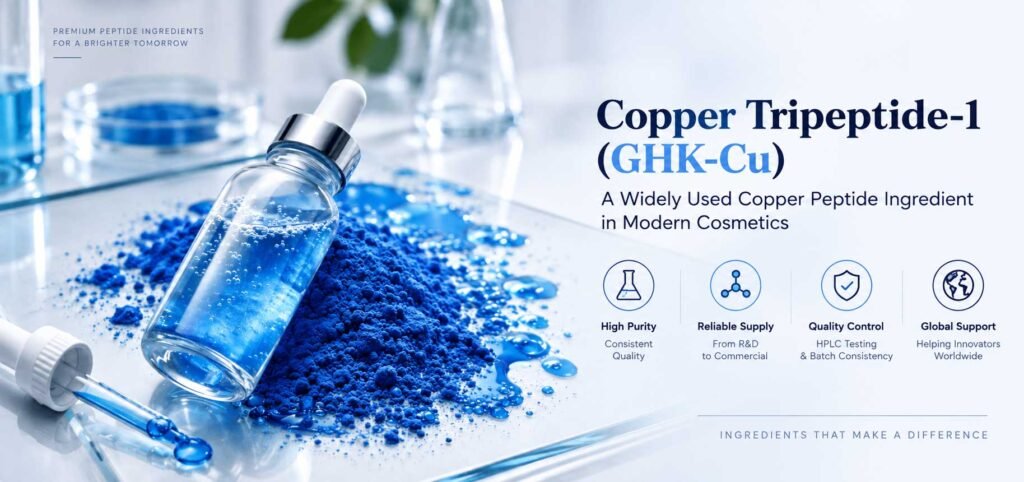
The commonly referenced Copper Tripeptide-1 CAS number is 89030-95-5. The material is also commonly described with the molecular formula C14H24CuN6O4 and a molecular weight of approximately 403.92 g/mol.
| Identification Item | Commonly Referenced Information |
| Ingredient | Copper Tripeptide-1 |
| Common technical name | GHK-Cu |
| INCI | Copper Tripeptide-1 |
| CAS No. | 89030-95-5 |
| Molecular formula | C14H24CuN6O4 |
| Molecular weight | Approx. 403.92 g/mol |
| Ingredient category | Copper peptide |
| Typical commercial form | Blue powder |
For an actual purchase, buyers should confirm these identity details against the supplier’s current specification and batch documentation.
What Is GHK-Cu Powder and Why Do Suppliers Use This Name?
GHK-Cu powder refers to the copper complex of GHK, a tripeptide composed of glycine, histidine, and lysine. The abbreviation is straightforward: GHK identifies the peptide sequence, while Cu denotes the associated copper.
This also explains why GHK and GHK-Cu should not be used carelessly as interchangeable terms. GHK describes the peptide itself, whereas GHK copper peptide or GHK-Cu identifies its copper complex.
For a cosmetic buyer, what is GHK-Cu is therefore more than a terminology question. The answer determines what should be requested in an RFQ and what should subsequently be verified on the specification and COA.
The name is widely used commercially because it is concise and recognizable to formulators. A supplier may consequently advertise a GHK-Cu cosmetic ingredient or GHK-Cu raw material while using Copper Tripeptide-1 in its formal cosmetic documentation.
When an RFQ specifies GHK-Cu, we recommend confirming the intended INCI identity and required specification before obtaining competing quotations. This small step prevents price comparisons between materials that may be described similarly but are not offered to equivalent quality requirements.
Copper Tripeptide-1 vs GHK-Cu: Key Differences in Naming and Commercial Use
A practical Copper Tripeptide-1 vs GHK-Cu difference becomes clearer when the two terms are compared according to where they are used.
| Purchasing Question | Copper Tripeptide-1 | GHK-Cu |
| Typical context | Cosmetic/INCI terminology | Scientific, technical and commercial terminology |
| Refers to copper-peptide complex | Yes | Yes |
| Frequently used by formulators | Yes | Yes |
| May appear on supplier documents | Yes | Yes |
| Defines exact commercial specification | No | No |
| Guarantees identical quality between suppliers | No | No |
In other words, a buyer researching GHK-Cu vs Copper Tripeptide-1 should not look for an artificial performance difference created purely by naming. The more useful distinction is how the terminology is being used and what specification sits behind it.
The same applies when “copper peptide” appears as a commercial description. In a GHK-Cu vs copper peptide comparison, copper peptide is a broader descriptive term and should not replace precise identity verification.
This is why procurement teams should avoid approving a substitute solely because a supplier presents GHK-Cu as a Copper Tripeptide-1 alternative name. Confirming identity is the first step; confirming equivalence requires specification and analytical comparison.
Why Copper Tripeptide-1 and GHK-Cu Specifications Can Differ Between Suppliers
If the names generally describe the same ingredient identity, why can two offers look so different?
The answer lies in manufacturing and quality specifications. Peptide synthesis produces a target material alongside process-related components that must be controlled through downstream purification. Purification strategy, analytical methodology, drying, handling, and storage can all influence the final commercial specification.
Purity and Assay Are Not Always Presented the Same Way
A quoted Copper Tripeptide-1 purity value is meaningful only when the buyer understands what was measured and by which method. HPLC purity, assay, peptide content, and other reported values are not automatically synonymous.
This is particularly important when evaluating GHK-Cu purity. A specification limit states the acceptance criterion, whereas a COA result represents the measured result for a particular batch. Procurement teams should distinguish between the two.
A supplier describing its material simply as high purity GHK-Cu powder should therefore be able to provide the corresponding analytical specification rather than relying on the phrase as a marketing claim.
Before comparing suppliers, request the Copper Tripeptide-1 specification and clarify the test method used for the principal quality parameter.
Product Form, Moisture and Other Quality Parameters Matter
Purity is only one part of raw-material qualification. Depending on the agreed specification, buyers may also need to evaluate appearance, moisture or water content, relevant impurity controls, heavy metals, microbiological requirements, and storage conditions.
This is particularly relevant when moving from a small qualification sample to repeated commercial orders. A specification should be sufficiently clear that purchasing and quality teams know what constitutes an acceptable future batch.
Copper Tripeptide-1 COA vs GHK-Cu COA: What Should Buyers Compare?
A Copper Tripeptide-1 COA should allow the buyer to determine whether a specific batch complies with the agreed specification. A GHK-Cu COA should serve the same purpose regardless of the naming convention used by the supplier.
The useful question is not which title appears at the top of the document, but whether the document contains enough batch-specific information to support qualification.
Key COA Items to Review Before Approving a Sample
| COA Item | Why It Matters to Buyers |
| Product identity | Confirms the material represented by the supplier |
| Batch/lot number | Connects results to a traceable production batch |
| Appearance | Provides a basic physical conformity check |
| Assay/purity | Supports evaluation against the agreed specification |
| Test method | Provides context for interpreting analytical results |
| Moisture/water | May influence material handling and specification |
| Heavy metals | Supports contaminant control where specified |
| Microbiology | Relevant where included in the agreed quality standard |
| Test results | Shows actual batch performance rather than specification limits alone |
| Storage information | Helps maintain material quality after receipt |
When comparing a Copper Tripeptide-1 specification with a GHK-Cu specification, procurement teams should align individual parameters and test methods instead of placing two COAs side by side and comparing only the largest percentage shown.
A reliable copper peptide COA should also be traceable to the material being sampled or shipped. Before a commercial order, buyers can ask whether the sample COA represents the actual sample batch and whether subsequent production will follow the same agreed specification.
Does Copper Tripeptide-1 vs GHK-Cu Matter in Cosmetic Formulation?
From a formulation perspective, the naming difference is usually less important than the characteristics of the material actually being incorporated.
A formulator working on a Copper Tripeptide-1 formulation should review the supplier’s technical information for solubility, concentration, processing temperature, pH considerations, and storage. The same principle applies to a GHK-Cu formulation.
For example, Copper Tripeptide-1 solubility needs to be considered within the intended formulation system rather than inferred solely from the ingredient name. Water quality, ingredient concentration, other formula components, and processing conditions can influence practical incorporation behavior. The same caution applies when reviewing GHK-Cu solubility information from different commercial sources.
Finished-product stability should be established in the complete formulation. A supplier can provide raw-material information, but the cosmetic manufacturer remains responsible for validating the final processing conditions and stability of its product.
For this reason, a copper peptide cosmetic formulation should be developed around the actual material specification rather than a generic online description of GHK-Cu.
Copper Tripeptide-1 Powder Price vs GHK-Cu Price: Why Quotes Vary
Copper Tripeptide-1 price comparisons become misleading when buyers compare quotations before aligning specifications. A lower number does not necessarily represent a lower cost for an equivalent material.
Several factors can affect a GHK-Cu powder price, including the agreed quality specification, synthesis and purification requirements, analytical testing, order quantity, packaging format, documentation requirements, and international logistics.
Quantity also matters. A small R&D package and a commercial order do not have the same packaging or handling economics. For this reason, a Copper Tripeptide-1 price per kg should always be considered alongside the quoted quantity and specification.
The same principle applies when evaluating a copper peptide powder price from several manufacturers. Before asking suppliers to match a competing quotation, procurement teams should first establish whether the offers cover comparable material.
A useful purchasing rule is simple: compare specifications before comparing quotations.
Once specification equivalence has been established, price becomes a much more meaningful commercial metric.
How to Buy Copper Tripeptide-1 or GHK-Cu Powder Without Sourcing the Wrong Material
Buyers planning to buy Copper Tripeptide-1 powder should make the RFQ technically specific enough to prevent ambiguity. “Please quote GHK-Cu” may produce several prices, but it may not produce comparable offers.
The same applies when companies buy GHK-Cu powder for formulation development or commercial production.
Buyer Checklist Before Requesting a Quotation
Before approving a supplier, confirm:
- ☐ Product and INCI identity
- ☐ CAS number
- ☐ Current specification
- ☐ Representative or batch-specific COA
- ☐ Principal assay/purity parameter
- ☐ Analytical method
- ☐ Required quantity
- ☐ Sample availability
- ☐ Packaging format
- ☐ Storage requirements
- ☐ Production or dispatch lead time
- ☐ Required technical/export documentation
For bulk Copper Tripeptide-1 powder, it is particularly important to confirm that the specification approved during sampling can be maintained for the commercial batch. Buyers should not assume that an inexpensive evaluation sample automatically represents subsequent production.
When requesting GHK-Cu bulk powder, provide the destination country and expected quantity as well. These details allow the supplier to evaluate packaging and logistics requirements more accurately.
The Copper Tripeptide-1 MOQ should also be considered in context. An R&D laboratory may need only a small qualification quantity, while a contract manufacturer may need a supply arrangement capable of scaling after formula approval.
How to Evaluate a Copper Tripeptide-1 / GHK-Cu Supplier
A Copper Tripeptide-1 supplier should be evaluated on evidence of manufacturing and quality control rather than website claims alone. The same applies when qualifying a GHK-Cu supplier for recurring commercial purchasing.
Useful questions include:
- Are you the actual manufacturer or a distributor?
- What peptide synthesis capabilities do you have?
- How is the material purified?
- What analytical method is used for the primary quality specification?
- Can you provide a batch-specific COA?
- Can we evaluate a sample before commercial purchasing?
- Will commercial batches follow the same specification?
- Which technical documents are available?
- Which packaging sizes can you supply?
- What lead time should we expect for repeat orders?
These questions help distinguish a reliable GHK-Cu supplier from a company that can provide a quotation but has limited control over manufacturing, analytical testing, or batch consistency.
For projects where direct manufacturing oversight matters, buyers can also ask a Copper Tripeptide-1 manufacturer about synthesis equipment, purification capacity, analytical instrumentation, batch traceability, and scale-up support. These details provide more useful qualification evidence than a generic claim of being a professional copper peptide manufacturer.
How CHEN LANG BIO TECH Supplies Copper Tripeptide-1 Powder
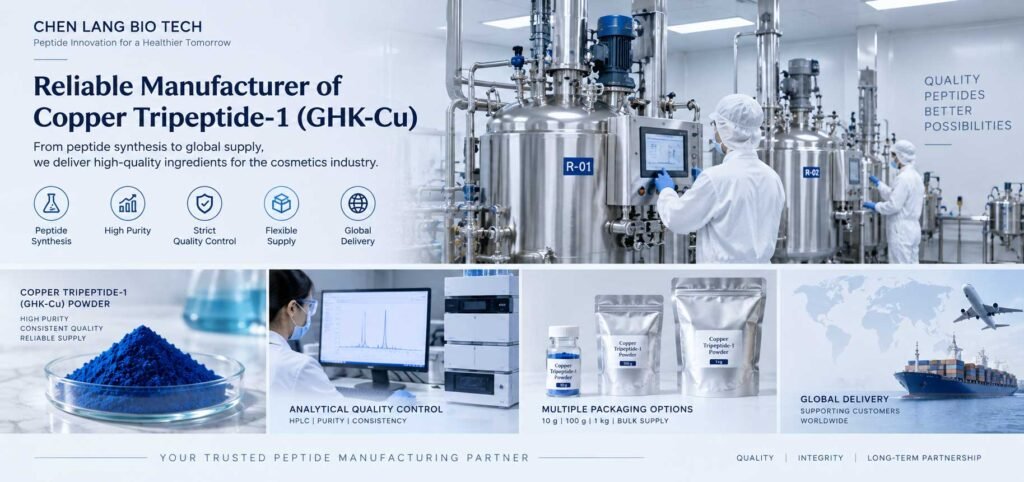
CHEN LANG BIO TECH works with peptide raw materials from synthesis through separation, purification, quality evaluation, and commercial supply. Our peptide production platform includes solid- and liquid-phase synthesis capabilities, multiple production-scale reaction systems, six preparative HPLC systems with columns of 150 mm and above, and more than 20 semi-preparative HPLC units.
As a Copper Tripeptide-1 powder supplier, we support customers at different stages of product development rather than limiting supply to large commercial quantities. Buyers can request technical information and evaluate a smaller quantity before moving to routine purchasing.
Available packaging includes 10 g bottles, 100 g aluminum foil bags, and 1 kg aluminum foil bags, with larger commercial arrangements confirmed according to the order. COA, SDS/MSDS, specification information, and other available technical documentation can be discussed during qualification.
Customers looking for a GHK-Cu powder supplier can send us their required specification, quantity, destination, and documentation requirements so that the quotation reflects the actual project rather than a generic catalogue price.
For bulk copper peptide powder, commercial availability and lead time can be confirmed before order placement.
Copper Tripeptide-1 vs GHK-Cu: Final Buying Takeaway
For cosmetic ingredient sourcing, Copper Tripeptide-1 and GHK-Cu generally describe the same copper-peptide ingredient identity, with Copper Tripeptide-1 commonly used as the cosmetic INCI terminology and GHK-Cu widely used in scientific and commercial contexts.
That answer should be the beginning of supplier qualification, not the end of it.
A sound purchasing sequence is:
Identity → specification → analytical method → COA → sample → supplier qualification → commercial batch
If you are evaluating Copper Tripeptide-1 for a new formulation, CHEN LANG BIO TECH can provide available specifications, documentation, sample information, packaging options, and a quotation based on your required quantity.
Email: extract@chenlangbio.com
Frequently Asked Questions About Copper Tripeptide-1 and GHK-Cu
Is Copper Tripeptide-1 the same as GHK-Cu?
In cosmetic sourcing, Copper Tripeptide-1 and GHK-Cu are commonly used to describe the same copper complex associated with the GHK tripeptide. Copper Tripeptide-1 is the INCI terminology, while GHK-Cu is widely used in scientific and commercial communication. Buyers should nevertheless compare specifications before treating materials from different suppliers as equivalent.
What is the difference between GHK and GHK-Cu?
In a GHK vs GHK-Cu comparison, GHK refers to the tripeptide glycyl-L-histidyl-L-lysine, while GHK-Cu refers to its copper complex. This distinction matters when preparing RFQs because a request for GHK alone does not necessarily identify the same commercial material as a request for GHK-Cu.
Is Copper Tripeptide-1 the INCI name for GHK-Cu?
Copper Tripeptide-1 INCI terminology is commonly used for the GHK copper complex in cosmetic ingredient documentation. When sourcing material, buyers should confirm that the supplier’s product identity, specification, CAS information, and COA correspond to the material required for their formulation.
What is the CAS number of Copper Tripeptide-1?
The commonly referenced Copper Tripeptide-1 CAS number is 89030-95-5. Because commercial documentation can use different naming conventions, procurement teams should verify the CAS number together with the INCI name and supplier specification rather than using any single identifier in isolation.
How can buyers compare Copper Tripeptide-1 purity?
When comparing Copper Tripeptide-1 purity, determine whether suppliers are reporting assay, HPLC purity, peptide content, or another parameter. Buyers should request the test method and compare like-for-like analytical values. A higher percentage is not meaningful if the underlying methods or definitions are different.
What should a GHK-Cu COA include?
A GHK-Cu COA should clearly identify the material and batch and report results against the supplier’s agreed specification. Depending on that specification, relevant information may include appearance, assay or purity, moisture, heavy metals, microbiological parameters, and other quality controls, together with sufficient batch information for traceability.
Why does GHK-Cu powder price vary between suppliers?
GHK-Cu powder price can vary because suppliers may offer different specifications, purification levels, analytical controls, quantities, packaging formats, documentation, and logistics terms. Buyers should therefore align the technical requirements first and compare prices only after confirming that the quotations represent materially comparable products.
Where can I buy Copper Tripeptide-1 powder in bulk?
Companies looking to buy Copper Tripeptide-1 powder for cosmetic formulation or ingredient distribution can source it directly from CHEN LANG BIO TECH. We support sample evaluation and bulk Copper Tripeptide-1 powder orders with available COA, technical documentation, multiple packaging options, and international supply support. For an accurate quotation, provide the required quantity, destination country, and specification requirements.