
Introduction
The demand for pdrn powder for skincare has increased significantly as the global cosmetic and aesthetic industry continues to shift toward biologically active and scientifically driven ingredients. Among these, regenerative skincare ingredients derived from polynucleotide technology have gained strong attention from formulation developers, OEM manufacturers, and raw material distributors.
As a specialized pdrn powder supplier, the market requirement today is no longer limited to basic ingredient supply. Buyers are increasingly focused on consistency, documentation, and manufacturing transparency, especially when sourcing high purity PDRN raw material for advanced skincare systems. This reflects a broader industry shift from commodity-based sourcing to science-driven ingredient selection.
Unlike conventional cosmetic actives, pdrn powder for skincare formulations requires precise control over molecular structure, purification levels, and microbial safety. These factors directly influence formulation stability, compatibility with other actives, and final product performance in premium skincare systems such as serums, ampoules, and skin booster products.
For global brands and OEM partners, selecting a reliable cosmetic raw material supplier is not just a procurement decision. It is a strategic choice that impacts product positioning, regulatory compliance, and long-term brand competitiveness in the regenerative skincare market.
This article provides a structured overview of PDRN powder manufacturing, its application in regenerative skincare formulations, and key considerations when evaluating a professional PDRN supplier or manufacturer.
What Is PDRN Powder and Why It Is Used in Skincare Formulations
PDRN powder refers to a purified form of polydeoxyribonucleotide derived from salmon DNA, processed through controlled enzymatic and purification technologies. It belongs to the broader category of polynucleotide skincare ingredients, which are widely used in advanced cosmetic and aesthetic formulations.
The reason pdrn powder for skincare has gained increasing attention lies in its structural compatibility with biological systems and its stability in formulation environments. Unlike many synthetic cosmetic actives, PDRN is derived from natural DNA fragments, which makes it suitable for high-end skincare development focused on regenerative concepts.
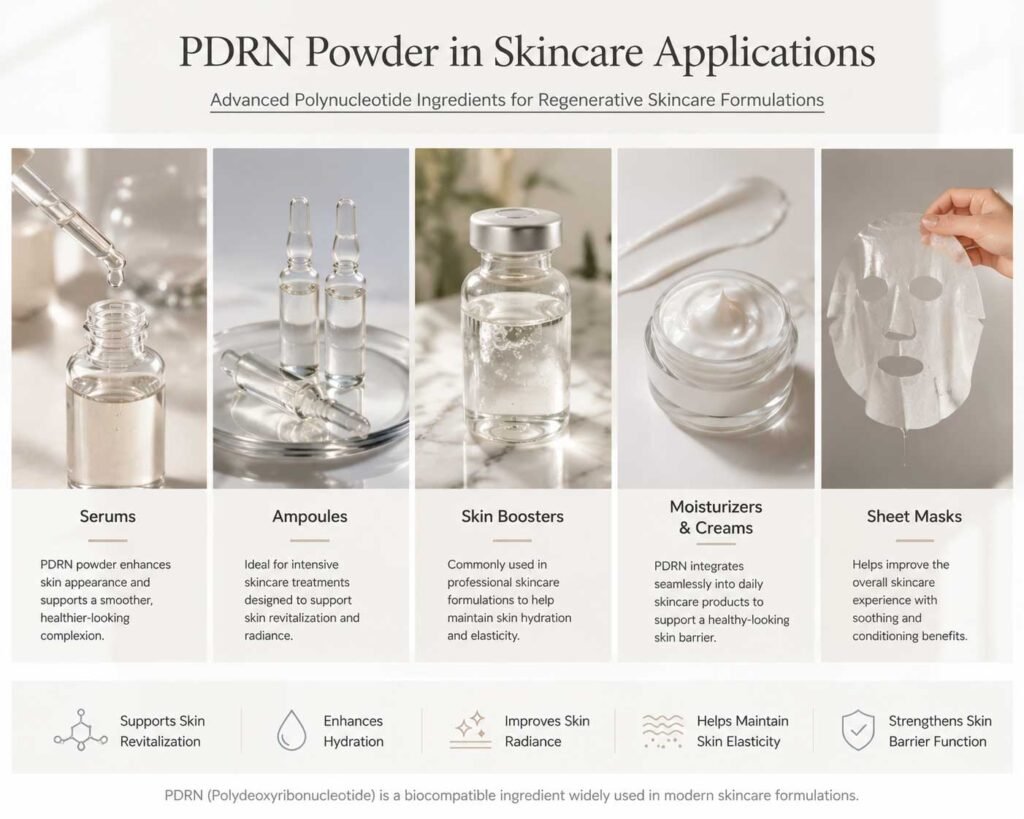
From a formulation perspective, salmon DNA PDRN powder is valued for its consistency, molecular uniformity, and compatibility with multi-ingredient systems. It is commonly incorporated into serums, ampoules, and professional skincare formulations, where ingredient stability and performance consistency are critical.
In the supply chain, a qualified pdrn raw material supplier must ensure that the product meets strict quality parameters, including molecular weight control, purification efficiency, and microbial safety. These factors are essential for maintaining formulation integrity and ensuring that regenerative skincare ingredients perform reliably across different product systems.
As demand continues to grow, PDRN powder supplier networks are increasingly evaluated based on technical capability rather than price alone. Buyers are looking for manufacturers that can provide stable production, clear documentation, and long-term supply reliability for OEM and private-label projects.
Manufacturing Process of PDRN Powder
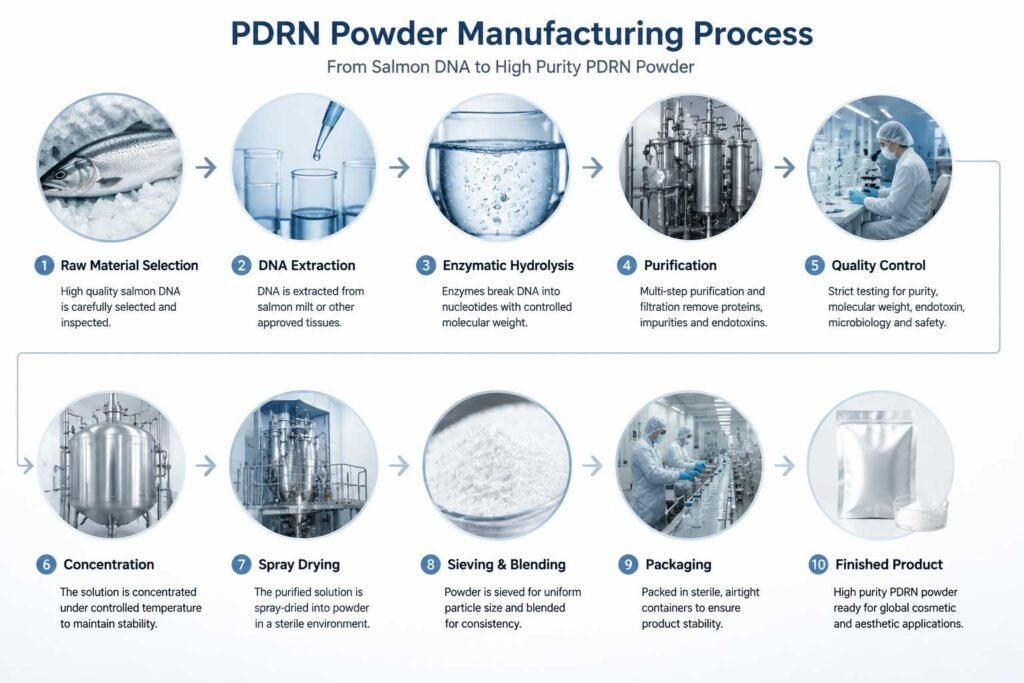
The production of pdrn powder for skincare formulations involves a highly controlled manufacturing process designed to ensure purity, stability, and molecular consistency. A professional pdrn manufacturer typically operates under GMP-aligned systems to guarantee reproducibility and quality control across all batches.
The process begins with carefully sourced salmon DNA raw material, which serves as the biological foundation for PDRN extraction. The quality of this starting material is critical, as it directly affects the final molecular structure and performance of the high purity PDRN powder.
Through enzymatic hydrolysis, DNA chains are broken down into controlled nucleotide fragments. This stage is carefully monitored to ensure that molecular weight distribution remains within a defined range suitable for skincare applications. Precision at this stage is essential for maintaining consistency in regenerative skincare formulations.
Following hydrolysis, the material undergoes multiple purification steps, including filtration and impurity removal. These steps eliminate proteins, peptides, and unwanted biological residues, resulting in a refined PDRN raw material suitable for cosmetic formulation use.
A key part of manufacturing is endotoxin and microbial control. A reliable pdrn powder supplier must ensure that microbial limits are strictly controlled and that endotoxin levels remain within safe thresholds suitable for cosmetic-grade applications. This is particularly important for brands developing high-end skincare systems that require consistent safety and stability profiles.
Quality control is validated through full batch testing, including COA (Certificate of Analysis), MSDS, and TDS documentation. These reports provide detailed insights into purity, molecular weight distribution, and overall batch consistency. For OEM buyers, this documentation is essential for formulation approval and regulatory review.
Finally, the finished PDRN powder is processed under controlled environmental conditions and packaged to maintain long-term stability. Proper storage and handling ensure that the material retains its functional integrity throughout transportation and downstream formulation use.
Regenerative Skincare Applications of PDRN Powder
The use of pdrn powder for skincare applications has expanded rapidly in the global beauty and aesthetic industry, particularly within the regenerative skincare segment. This growth is driven by increasing demand for high-performance polynucleotide skincare ingredients that support advanced formulation strategies.
One of the most common applications is in serum and ampoule formulations, where PDRN powder for skincare systems is integrated as a key functional ingredient. These products are typically positioned in premium skincare categories and are designed for professional or high-end consumer use.
Another important application area is skin booster formulations, where PDRN is used as part of multi-ingredient systems designed to enhance product differentiation and performance positioning. In this context, formulation developers prioritize high purity PDRN raw material to ensure consistency and compatibility with other active ingredients.
In addition, regenerative skincare ingredients such as PDRN are increasingly used in OEM and private-label product development. Brands working with a qualified cosmetic raw material supplier often integrate PDRN into product lines targeting anti-aging, hydration, and skin conditioning segments.
From a commercial perspective, demand for pdrn powder supplier products continues to grow across Asia, Europe, and the Middle East. This reflects a broader trend toward science-based skincare formulations, where ingredient transparency and technical documentation are becoming key purchasing criteria.
For OEM manufacturers, the flexibility of PDRN powder for skincare formulation use allows integration into a wide range of product systems, making it a valuable ingredient for product innovation and market differentiation.
PDRN Powder Supplier and OEM Manufacturing Capabilities
Selecting a reliable pdrn powder supplier is a critical step for brands developing regenerative skincare products. Beyond ingredient quality, buyers must evaluate manufacturing capability, documentation standards, and long-term supply stability.
A professional PDRN manufacturer should offer flexible OEM and bulk supply capabilities, including support for different packaging sizes, formulation requirements, and private-label production needs. This is especially important for companies sourcing bulk PDRN powder supplier materials for large-scale production.
Documentation is a key requirement in supplier evaluation. A qualified supplier must provide complete technical packages, including COA, MSDS, and TDS, to ensure transparency in purity levels, molecular structure, and safety parameters. These documents are essential for formulation validation and regulatory compliance in international markets.
Consistency is another critical factor. A reliable pdrn raw material supplier must ensure batch-to-batch stability, especially when supplying ingredients for high-performance skincare systems. This includes maintaining controlled molecular weight distribution and standardized purification processes.
OEM capability is also an important consideration. Many skincare brands require customized solutions, including specific concentration levels, packaging formats, and formulation guidance. A strong cosmetic raw material supplier should be able to support these requirements while maintaining quality consistency.
For global buyers, choosing the right pdrn powder supplier for skincare development is ultimately about balancing technical capability, supply chain reliability, and long-term partnership potential.
Injectable Grade vs Cosmetic Grade PDRN Powder
In global sourcing and formulation development, understanding the difference between injectable grade PDRN powder and cosmetic grade material is essential for making informed procurement decisions. Although both originate from salmon DNA polynucleotide systems, their production standards, purification levels, and intended applications differ significantly.
Injectable grade PDRN powder is manufactured under stricter quality control conditions, with enhanced requirements for endotoxin limitation, molecular weight consistency, and microbial safety. These parameters are critical for professional aesthetic applications, particularly in advanced formulations such as mesotherapy systems and skin booster products where stability and batch consistency are essential.
In contrast, cosmetic grade PDRN raw material is primarily used in topical skincare formulations such as creams, serums, and emulsions. While still requiring controlled production and quality assurance, its specifications are generally more flexible compared to injectable-grade standards.
From a procurement perspective, many brands compare injectable vs cosmetic PDRN powder when evaluating product development strategies. The decision often depends on target market positioning, regulatory requirements, and the technical capabilities of the pdrn powder supplier or manufacturer.
Understanding this distinction allows formulation teams to align ingredient selection with product strategy, ensuring that regenerative skincare ingredients are used in the most appropriate formulation systems.
Market Trends of PDRN Powder in Regenerative Skincare
The global demand for pdrn powder for skincare formulations continues to grow as the beauty and aesthetic industry shifts toward science-driven and biotechnology-based ingredients. This trend is particularly strong in the regenerative skincare segment, where polynucleotide skincare ingredients are increasingly used in premium product development.
One of the key drivers of market growth is the rising demand for high purity PDRN raw material in OEM and private-label skincare manufacturing. Brands are actively seeking reliable pdrn powder suppliers capable of providing consistent quality, technical documentation, and scalable production capacity.
Another important trend is the expansion of regenerative skincare ingredients into multiple product categories, including professional serums, ampoules, and advanced skin booster systems. These formulations are often positioned in high-end skincare markets where ingredient transparency and scientific credibility are critical purchasing factors.
Geographically, demand is expanding across Asia, Europe, and the Middle East. In these regions, skincare brands and OEM manufacturers are increasingly working with cosmetic raw material suppliers that can support advanced formulation development and bulk supply requirements.
Overall, the market outlook for pdrn powder for skincare applications remains strong, driven by continuous innovation in formulation science and growing consumer interest in biotech-based skincare solutions.
Frequently Asked Questions (FAQ)
1. What is PDRN powder used for in skincare?
PDRN powder for skincare is used as a functional ingredient in regenerative skincare formulations such as serums, ampoules, and skin booster systems developed by cosmetic and OEM manufacturers.
2. Is PDRN a natural ingredient?
Yes, salmon DNA PDRN powder is derived from natural biological sources and processed through controlled purification methods to ensure consistency and safety for cosmetic use.
3. What is the difference between PDRN and PN?
PDRN is a specific type of polynucleotide with controlled molecular structure, while PN refers to a broader category of nucleotide-based ingredients used in skincare formulations.
4. How is PDRN powder manufactured?
PDRN powder manufacturing involves enzymatic hydrolysis, purification, molecular weight control, and strict quality testing including COA, MSDS, and microbial analysis.
5. What should buyers consider when choosing a PDRN supplier?
Buyers should evaluate GMP compliance, batch consistency, documentation standards, and OEM capability when selecting a pdrn powder supplier.
6. Can PDRN be used in OEM skincare products?
Yes, PDRN raw material is widely used in OEM and private-label skincare formulations across global cosmetic manufacturing markets.
Conclusion
The growing demand for pdrn powder for skincare formulations reflects a broader shift in the cosmetic industry toward biotechnology-driven and regenerative ingredient systems. As brands increasingly adopt regenerative skincare ingredients, the importance of selecting a reliable pdrn powder supplier continues to increase.
From manufacturing to formulation, consistency in high purity PDRN raw material is essential for ensuring product performance, stability, and market competitiveness. For OEM manufacturers and skincare brands, working with an experienced cosmetic raw material supplier helps ensure both technical reliability and scalable production capability.
For formulation teams, technical documentation and supply chain transparency remain key factors in supplier selection. Detailed specifications such as COA, MSDS, and TDS are typically required when evaluating PDRN powder for skincare development.
For technical inquiries, OEM cooperation, or bulk supply requirements, communication can be initiated through extract@chenlangbio.com. This allows formulation developers and procurement teams to access detailed product specifications and technical support related to PDRN raw material sourcing and OEM development.