Hydration plays a central role in maintaining healthy skin and developing effective cosmetic formulations. As skincare science continues to evolve, formulators are increasingly seeking ingredients capable of delivering deeper hydration, longer moisture retention, and improved skin barrier performance.
Among the most widely discussed moisturizing ingredients today are sodium polyglutamate and hyaluronic acid. Both ingredients are recognized for their powerful humectant properties and are commonly used in premium skincare formulations such as serums, moisturizers, and facial masks.
However, cosmetic scientists and product developers often ask an important question when comparing sodium polyglutamate vs hyaluronic acid:
Which ingredient provides stronger hydration and better long-term moisture retention?
While hyaluronic acid has long been considered the benchmark for skin hydration, emerging research suggests that sodium polyglutamate, a fermentation-derived biopolymer, may provide even greater water-binding capacity and improved moisture retention on the skin surface.
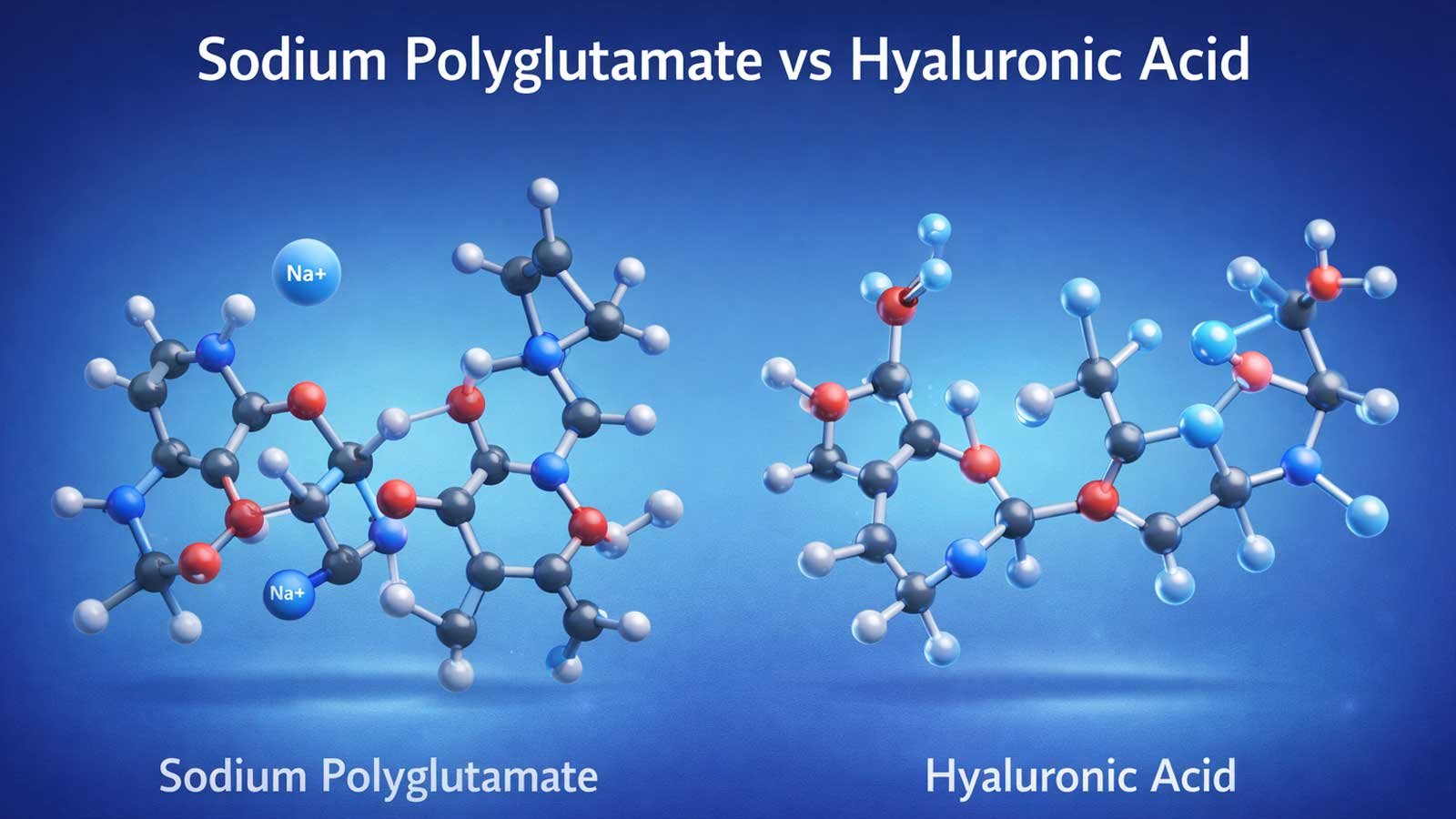
This article provides a scientific comparison of sodium polyglutamate vs hyaluronic acid, examining their hydration mechanisms, formulation performance, and real-world cosmetic applications.
Summary: Sodium Polyglutamate vs Hyaluronic Acid Hydration Comparison
When comparing sodium polyglutamate vs hyaluronic acid, both ingredients are widely recognized as powerful moisturizing agents in modern skincare formulations. However, their hydration mechanisms and moisture retention capabilities differ.
The key hydration differences between sodium polyglutamate and hyaluronic acid are summarized below.
| Feature | Sodium Polyglutamate | Hyaluronic Acid |
| Ingredient type | Fermentation-derived biopolymer | Natural polysaccharide |
| Water-binding capacity | ≈ 5,000× its weight in water | ≈ 1,000–1,250× its weight |
| Hydration mechanism | Humectant + moisture-locking film | Strong humectant |
| Moisture retention | Long-lasting hydration | Immediate hydration |
| Skin barrier support | Forms protective hydration film | Limited barrier support |
| Typical cosmetic applications | Serums, sheet masks, anti-aging skincare | Serums, creams, moisturizers |
Key Insight
Scientific studies indicate that polyglutamic acid (sodium polyglutamate) can bind significantly more water than hyaluronic acid, with laboratory measurements suggesting up to five times higher theoretical water-binding capacity. This makes sodium polyglutamate an increasingly popular ingredient in advanced skincare formulations designed for long-lasting hydration.
What Is Sodium Polyglutamate?
Sodium polyglutamate is the sodium salt form of polyglutamic acid, a naturally occurring biopolymer produced through microbial fermentation. It has become increasingly popular as a high-performance sodium polyglutamate cosmetic ingredient due to its exceptional ability to bind water and form a protective moisture film on the skin.
Polyglutamic acid was originally discovered in fermented foods such as natto, where it contributes to the characteristic viscous texture. In cosmetic formulations, however, purified sodium polyglutamate is used for its superior moisturizing functionality.
Key properties of sodium polyglutamate in cosmetics include:
- extremely high water-binding capacity
- strong film-forming ability
- improved moisture retention
- enhanced skin barrier support
- excellent compatibility with skincare formulations
Because of these characteristics, sodium polyglutamate moisturizing ingredient technology is increasingly used in premium hydration products.
What Is Hyaluronic Acid?
Hyaluronic acid is a naturally occurring glycosaminoglycan found in connective tissue, skin, and synovial fluid. It plays an essential role in maintaining skin hydration and elasticity.
As a well-established hyaluronic acid moisturizing ingredient, it is widely used in cosmetic formulations due to its ability to attract and retain water molecules.
Different molecular weights of hyaluronic acid are used in skincare products to achieve specific effects:
- high molecular weight HA → surface hydration
- low molecular weight HA → deeper skin penetration
- cross-linked HA → long-lasting moisture retention
Because of its strong hyaluronic acid skin hydration performance, it remains a core ingredient in many cosmetic formulations.
Sodium Polyglutamate vs Hyaluronic Acid: A Scientific Comparison of Hydration Performance
When discussing sodium polyglutamate vs hyaluronic acid, many articles focus only on theoretical water-binding capacity. However, in cosmetic science, the effectiveness of a moisturizing ingredient depends on multiple factors, including hydrophilicity, moisture retention ability, skin surface protection, molecular weight behavior, and formulation compatibility.
Understanding these dimensions allows formulators and skincare brands to make more informed decisions when selecting moisturizing ingredients.
Key Hydration Comparison: Sodium Polyglutamate vs Hyaluronic Acid
The major differences between sodium polyglutamate and hyaluronic acid are summarized below.
| Comparison Factor | Sodium Polyglutamate | Hyaluronic Acid |
| Hydrophilicity | Highly hydrophilic biopolymer with strong affinity for water molecules | Highly hydrophilic glycosaminoglycan widely known for water binding |
| Water-binding capacity | Frequently cited up to ≈5000× its weight in water | Commonly reported ≈1000–1250× its weight in water |
| Moisture retention | Strong moisture retention due to film-forming barrier | Excellent humectant effect with rapid hydration |
| Skin surface protection | Forms a protective hydration film that helps reduce water evaporation | High molecular weight HA forms viscoelastic surface film |
| Penetration behavior | Molecular-weight dependent; lower MW may penetrate deeper | Molecular-weight dependent; low MW penetrates more easily |
| Formulation role | Moisture-locking and long-lasting hydration | Immediate hydration and skin plumping |
Key insight
Scientific literature suggests that polyglutamic acid (sodium polyglutamate) may exhibit higher theoretical water-binding capacity than hyaluronic acid, while hyaluronic acid remains one of the most extensively studied moisturizing ingredients in dermatological and cosmetic research.
Hydrophilicity and Water Affinity
Both sodium polyglutamate and hyaluronic acid are highly hydrophilic molecules, meaning they strongly attract and retain water.
Polyglutamic acid is a fermentation-derived polymer composed of glutamic acid units. Its molecular structure contains numerous hydrophilic functional groups capable of interacting with water molecules, allowing it to bind substantial amounts of moisture.
Hyaluronic acid, a naturally occurring polysaccharide in human connective tissue, also possesses strong water-binding ability due to its repeating disaccharide structure.
From a theoretical standpoint, cosmetic literature often cites polyglutamic acid as having higher water-binding potential, although both ingredients function effectively as humectants in skincare formulations.
Moisture Retention and Long-Lasting Hydration
While water-binding capacity is important, moisture retention over time is often more relevant in real skincare products.
Research summarized in cosmetic science literature reports that polyglutamic acid formulations demonstrated approximately 45% water retention after 120 minutes, compared with about 36% for hyaluronic acid in a specific volunteer skin hydration test.
However, other laboratory comparisons have produced different rankings depending on test conditions. In one gravimetric study comparing humectants in solution, the moisture retention performance ranked hyaluronic acid > γ-polyglutamic acid > glycerin.
These variations highlight an important point:
moisturizing performance depends heavily on formulation conditions, including concentration, molecular weight, pH, and environmental humidity.
For this reason, professional formulators often evaluate both ingredients within the context of the finished product.
Skin Surface Protection and Barrier Support
One of the distinctive advantages frequently associated with sodium polyglutamate is its ability to form a thin moisture-retaining film on the skin surface.
This film helps:
- reduce transepidermal water loss (TEWL)
- maintain hydration over longer periods
- improve skin smoothness and softness
High-molecular-weight hyaluronic acid also forms a viscoelastic film on the skin surface and can support barrier function, although its mechanism primarily relies on strong humectant activity.
As a result, both ingredients contribute to skin surface protection, but they may do so through slightly different mechanisms.
Molecular Weight and Skin Penetration
Another key factor in the sodium polyglutamate vs hyaluronic acid comparison is molecular weight.
For hyaluronic acid:
- High molecular weight HA primarily hydrates the skin surface
- Low molecular weight HA can penetrate more deeply into the epidermis
A similar principle is believed to apply to polyglutamic acid:
- High MW PGA acts mainly as a surface moisture-locking film
- Lower MW PGA may penetrate more effectively and contribute to deeper hydration
These molecular weight variations explain why cosmetic manufacturers often use multi-weight hydration systems in modern skincare products.
Why Many Skincare Formulations Combine Sodium Polyglutamate and Hyaluronic Acid
In professional cosmetic formulation, the discussion of sodium polyglutamate vs hyaluronic acid is rarely about choosing one ingredient over the other.
Instead, many modern skincare formulations combine both ingredients to create multi-layer hydration systems.
Typical benefits of combining them include:
- rapid hydration from hyaluronic acid
- improved moisture retention from sodium polyglutamate
- enhanced skin barrier support
- longer-lasting skin hydration
This synergy explains why both ingredients are frequently used together in high-performance skincare products such as hydrating serums, facial masks, and anti-aging creams.
Applications of Sodium Polyglutamate in Skincare Formulations
Today, sodium polyglutamate in skincare is used in a wide range of cosmetic products, particularly those designed for hydration and anti-aging.
Typical applications include:
- hydrating serums
- moisturizing creams
- anti-aging treatments
- sheet masks
- dermal repair products
As consumer demand for advanced hydration ingredients continues to grow, the use of sodium polyglutamate skincare ingredient technology is expected to expand further across the cosmetic industry.
Frequently Asked Questions
Is sodium polyglutamate better than hyaluronic acid for hydration?
When comparing sodium polyglutamate vs hyaluronic acid, studies suggest that polyglutamic acid can bind up to 5,000 times its weight in water, while hyaluronic acid typically binds around 1,000–1,250 times its weight. This means sodium polyglutamate may provide stronger moisture retention, although both ingredients are commonly used together for optimal skincare hydration.
Can sodium polyglutamate replace hyaluronic acid in skincare formulations?
In most formulations, sodium polyglutamate does not fully replace hyaluronic acid but complements it. Hyaluronic acid delivers rapid hydration, while sodium polyglutamate helps lock in moisture by forming a protective hydration film on the skin surface. Many modern skincare products combine both ingredients to enhance overall hydration performance.
What makes sodium polyglutamate a powerful moisturizing ingredient?
Sodium polyglutamate is considered a powerful moisturizing ingredient in cosmetics because of its exceptional water-binding capacity and film-forming ability. It helps attract moisture while also reducing transepidermal water loss, allowing skin to remain hydrated for longer periods compared with many traditional humectants.
Is sodium polyglutamate safe for skin?
Yes, sodium polyglutamate is widely regarded as a safe cosmetic ingredient. It is derived from microbial fermentation and has excellent biocompatibility with the skin. Due to its mild nature and strong hydration benefits, it is commonly used in skincare products such as serums, creams, and facial masks.
What types of skincare products use sodium polyglutamate?
Sodium polyglutamate in skincare is commonly used in hydrating serums, moisturizing creams, anti-aging products, and sheet masks. Because of its superior moisture retention properties, it is often included in formulations designed to improve skin hydration and support the skin barrier.
What is the recommended dosage of sodium polyglutamate in cosmetics?
In most cosmetic formulations, sodium polyglutamate is typically used at concentrations between 0.1% and 1%, depending on the product type and desired hydration performance. It is compatible with many cosmetic ingredients and can be used alongside humectants such as hyaluronic acid and glycerin.
Sodium Polyglutamate vs Hyaluronic Acid: Final Conclusion
The comparison of sodium polyglutamate vs hyaluronic acid demonstrates that both ingredients are highly effective moisturizing agents, but they function through different mechanisms.
Hyaluronic acid remains an excellent humectant capable of delivering rapid hydration and improving skin appearance.
However, sodium polyglutamate offers several additional advantages, including superior theoretical water-binding capacity and enhanced moisture retention due to its film-forming properties.
For modern skincare formulations, the most effective strategy is often a synergistic combination of both ingredients, allowing cosmetic products to deliver immediate hydration while maintaining long-lasting moisture retention.
Work With a Professional Sodium Polyglutamate Supplier
For cosmetic manufacturers and skincare brands, sourcing high-quality raw materials is critical to ensuring product performance and formulation stability.
When selecting a sodium polyglutamate supplier, factors such as fermentation technology, molecular weight control, ingredient purity, and supply stability should be carefully evaluated.
At CHEN LANG BIO TECH, we specialize in supplying high-quality cosmetic ingredients for global skincare brands and manufacturers.
Our sodium polyglutamate cosmetic grade products are produced using advanced fermentation technology to ensure consistent quality, excellent hydration performance, and reliable supply for cosmetic formulations.
For sodium polyglutamate vs hyaluronic acid, product specifications, samples, or technical support, please feel free to contact us:
CHEN LANG BIO TECH
Website: https://www.natuactive.com
Email: extract@chenlangbio.com
We welcome inquiries from cosmetic brands, formulation laboratories, and ingredient distributors worldwide.
References
1, Shih, I. L., Van, Y. T., & Yeh, L. C. (2001). Production of poly(γ-glutamic acid) by microbial fermentation. Biotechnology Advances, 19(6), 401–414.
2, Papakonstantinou, E., Roth, M., & Karakiulakis, G. (2012). Hyaluronic acid: A key molecule in skin aging. Dermato-Endocrinology.
3, Cosmetics (MDPI). Polyglutamic Acid in Cosmetic Applications.
4, Biomolecules (MDPI). Topical and Dermatological Applications of Hyaluronic Acid.
5, International Journal of Pharmaceutics. Hyaluronic Acid in Transdermal and Dermal Drug Delivery.