
Copper Tripeptide-1 recommended use level is not simply a percentage copied from a supplier brochure. For a cosmetic formulator, the useful question is how much active GHK-Cu is actually being introduced into the finished product, and that depends on the form of the raw material, its assay, the formulation target, and the behavior of the complete system.
Copper Tripeptide-1, commonly referred to as GHK-Cu, is the copper complex of the tripeptide glycyl-L-histidyl-L-lysine. Its strong affinity for aqueous environments makes it attractive for serums, gels, emulsions, and other water-containing cosmetic systems. Published preformulation research reported log D values between −2.38 and −2.49 across pH 4.5–7.4, confirming the highly hydrophilic character of the material.
That does not mean every GHK-Cu raw material can be dosed in the same way. A high-assay powder, a diluted solution, and an encapsulated preparation may all be sold under descriptions containing “Copper Tripeptide-1,” while supplying very different quantities of active material per gram.
For formulators and ingredient buyers, a reliable use-level decision therefore starts with three questions: What exactly is the supplied material? What is its assay or active concentration? How much of that material is required to reach the intended concentration in the finished formula?
What Is the Recommended Use Level of Copper Tripeptide-1?
There is no single Copper Tripeptide-1 usage rate that should automatically be applied to every cosmetic formulation. Commercial recommendations need to be interpreted against the specification of the material being purchased.
This distinction is particularly important when comparing supplier literature. A percentage stated for a ready-to-use solution may describe the amount of the entire commercial preparation added to the formula, whereas a percentage for high-assay GHK-Cu powder refers to a much more concentrated raw material. Treating those numbers as interchangeable can produce a substantial formulation error.
For the same reason, a quoted GHK-Cu percentage in cosmetics does not tell a formulator enough unless the basis of that percentage is clear.
| Material being specified | What the percentage may represent | Why it matters |
|---|---|---|
| High-assay GHK-Cu powder | Raw peptide-copper material | Addition should reflect actual assay |
| Diluted solution | Entire liquid preparation | Active GHK-Cu may represent only part of the solution |
| Carrier or encapsulated system | Carrier plus incorporated active | Loading efficiency becomes relevant |
| Finished cosmetic | Total concentration in the final formula | Must not be confused with raw-material dosage |
A practical recommended concentration of GHK-Cu should therefore be established from the supplier’s technical specification and the formulation objective, then confirmed in the finished system through stability, compatibility, and performance testing.
This is more useful than treating one percentage found online as an industry-wide standard.
Copper Tripeptide-1 Concentration vs. Supplier Use Level: What Is the Difference?
One of the most common sources of confusion in peptide formulation is the difference between Copper Tripeptide-1 concentration and the addition rate of the commercial raw material.
Suppose Formulator A purchases a concentrated powder while Formulator B purchases a premixed aqueous ingredient. Even if both products are described as GHK-Cu, adding 0.1% of each does not necessarily introduce the same amount of active material.
Active Concentration Is Not Always the Same as Raw Material Addition Rate
Before calculating a GHK-Cu powder concentration, check the COA and technical specification for assay, active content, moisture where relevant, and the basis on which the specification is reported.
For high-assay powder, an assay correction can be made when the formulation requires a defined active equivalent:
Required raw material = target active amount ÷ assay fraction
For example, if a development calculation calls for 1.00 g of active equivalent and the raw material has a 98.0% assay:
1.00 g ÷ 0.98 = 1.020 g raw material
This is an assay-adjustment example, not a recommended cosmetic dosage.
The distinction becomes even more important for solutions. A formula containing 1% of a commercial ingredient that itself contains only a fraction of GHK-Cu is not equivalent to a formula containing 1% high-assay powder.
A technically meaningful copper peptide percentage calculation should always work backward from the material specification rather than the product name.
How Much GHK-Cu Powder Do You Need for a Cosmetic Batch?
Once the formulation team has established its target addition rate, calculating how much GHK-Cu powder to use is straightforward.
Assume, purely as a calculation example, that pilot work and the supplier’s technical guidance have established a raw-material addition rate of 0.10%. For a 1 kg laboratory batch:
1,000 g × 0.10% = 1.0 g
Scaling that formulation without changing the percentage gives:
| Batch size | Example addition rate* | Raw material required* |
|---|---|---|
| 1 kg | 0.10% | 1 g |
| 10 kg | 0.10% | 10 g |
| 100 kg | 0.10% | 100 g |
| 1,000 kg | 0.10% | 1 kg |
The 0.10% value is used only to demonstrate batch calculation and should not be interpreted as a universal recommended use level.
For commercial production, the calculation should go one step further. If the manufacturing specification controls active GHK-Cu rather than simply the weight of incoming powder, the actual batch quantity should reflect the approved assay calculation.
This matters during scale-up because a seemingly small difference becomes material at production scale. A 1% assay difference is almost irrelevant when weighing a few milligrams during exploratory work, but it can affect purchasing, batch reconciliation, and specification compliance when the ingredient is used repeatedly in larger production campaigns.
The same principle should be included in the formulation master record so that production personnel know whether the stated percentage represents nominal raw material or assay-adjusted active content.
Does a Higher Copper Tripeptide-1 Concentration Always Perform Better?
No. A higher GHK-Cu concentration for skincare should not automatically be interpreted as a better formulation.
A 2023 study examining GHK-Cu-loaded liposomes provides a useful example. Researchers evaluated anionic and cationic hydrogenated-lecithin liposomes and found that peptide concentration influenced encapsulation efficiency. At a total lipid concentration of 25 mg/cm³, increasing GHK-Cu in the hydration medium from 0.5 to 5 mg/cm³ reduced encapsulation efficiency from 31.7 ± 0.9% to 17.5 ± 1.3% in the anionic system and from 20.0 ± 2.8% to 6.9 ± 1.1% in the cationic system.
In other words, a tenfold increase in peptide concentration did not produce a tenfold improvement in carrier loading efficiency. The authors calculated decreases in encapsulation efficiency of approximately 1.8-fold and 2.9-fold for the anionic and cationic systems, respectively.
This does not establish a universal cosmetic dosage for GHK-Cu—the experiment concerned specific liposomal systems. It demonstrates a broader formulation principle: copper peptide concentration cannot be optimized independently of the delivery system.
The best use level is the one that performs appropriately in the actual formula, not simply the highest percentage that can be added.
Water Solubility, pH and Stability at Different GHK-Cu Use Levels
GHK-Cu’s physicochemical properties are favorable for aqueous formulation, but solubility and finished-product stability should be treated as separate questions.
A preformulation study reported log D values of −2.38 to −2.49 over pH 4.5–7.4, indicating that GHK-Cu is highly hydrophilic. This helps explain why Copper Tripeptide-1 water solubility is generally suitable for developing aqueous phases.
The same research provides valuable—but often oversimplified—stability information.
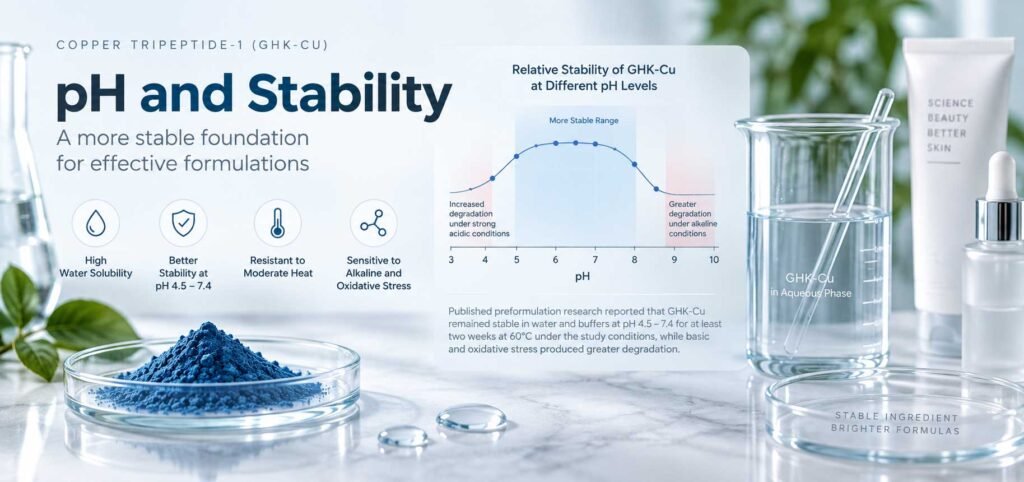
Under the experimental conditions, GHK-Cu remained stable in water and buffers between pH 4.5 and 7.4 for at least two weeks at 60°C. Basic and oxidative stress produced greater degradation, while acidic stress caused degradation to a lesser extent.
These results are useful when considering GHK-Cu pH stability, but pH 4.5–7.4 should not be converted into a blanket specification for every finished cosmetic.
A serum containing humectants and preservatives, for example, is chemically different from a buffer used in a controlled laboratory experiment. An emulsion introduces oils, emulsifiers, interfaces, and potentially charged components. Packaging, dissolved oxygen, trace metals, light exposure, and storage time add further variables.
The practical conclusion is therefore not “GHK-Cu is guaranteed stable at pH 4.5–7.4.” Rather, the published data provide a useful starting point from which the finished formulation should be validated.
How to Add Copper Tripeptide-1 Powder to a Cosmetic Formula
A useful GHK-Cu formulation guide needs to address processing as well as dosage.
For a water-based formulation, the peptide can generally be handled through an aqueous phase because of its hydrophilic nature. Purified or deionized water provides a controlled starting medium. The powder should be introduced under appropriate mixing and allowed to dissolve uniformly before the concentrate is incorporated into the larger batch.
Excessive shear should not be assumed to solve every dissolution problem. If visible particles persist, the formulator should first examine material identity, concentration, water quality, pH, and other ingredients already present in the phase.
When Should GHK-Cu Be Added?
Late-stage or cool-down incorporation can be a sensible development strategy because it limits unnecessary exposure to the most demanding parts of an emulsion process. However, statements such as “Copper Tripeptide-1 must always be added below 40°C” should not be presented as universal scientific rules without formulation-specific evidence.
The published preformulation work is particularly informative here: GHK-Cu remained stable for at least two weeks at 60°C in water and selected buffers under the study conditions. That does not justify prolonged high-temperature processing, but it does show why arbitrary temperature limits should not be confused with experimentally established degradation thresholds.
When deciding how to formulate with Copper Tripeptide-1, use the raw-material TDS as the initial processing reference and confirm the chosen procedure in the actual formula.
Copper Tripeptide-1 Use Levels for Serums, Creams and Other Cosmetic Systems
Product format alone does not determine the correct Copper Tripeptide-1 formulation percentage.
A facial serum and a cream may ultimately use different quantities, but the difference should come from formulation design rather than an assumption that every serum requires one percentage and every cream another.
| Cosmetic system | Important formulation considerations |
|---|---|
| Facial serum | Aqueous solubility, clarity, pH and preservation |
| Cream or lotion | Phase selection, emulsifier compatibility and processing |
| Eye-area formulation | Finished-formula tolerance and claim substantiation |
| Hydrogel | Polymer, electrolyte and pH compatibility |
| Scalp serum | Solubility, preservation and packaging compatibility |
When developing Copper Tripeptide-1 in serum, formulators should pay particular attention to clarity and precipitation during stability testing. A clear solution immediately after manufacturing does not by itself demonstrate long-term compatibility.
For a copper peptide cream formulation, the peptide also encounters an oil-water interface, emulsifier system, thickeners, preservatives, and other functional ingredients. The complete formulation therefore needs evaluation rather than assuming that behavior observed in water will transfer directly to an emulsion.
This is one reason a formulation trial with the actual production-grade raw material is valuable before moving from laboratory development to commercial purchasing.
What Ingredients Can Affect GHK-Cu Stability and Compatibility?
Ingredient compatibility cannot be reduced to the popular online lists of products that supposedly “can” or “cannot” be combined with copper peptides.
Published GHK-Cu compatibility research gives a more useful picture. In the preformulation study discussed above, the complex was compatible with Span 60-based niosomes but showed lower stability in the presence of negatively charged dicetyl phosphate.
The same work found susceptibility to degradation under basic and oxidative stress. Those findings suggest that formulators should pay particular attention to the chemical environment surrounding the peptide rather than evaluating ingredients only by their marketing categories.
Carrier systems deserve similar consideration. The 2023 liposome study produced stable GHK-Cu-loaded systems of approximately 100 nm, but encapsulation efficiency changed with lipid composition, lipid concentration, and peptide loading.
Consequently, Copper Tripeptide-1 stability should be tested in the complete prototype. Useful development work can include appearance and color monitoring, pH, precipitation or phase separation observations, assay where available, accelerated stability, and packaging compatibility.
How Raw Material Quality Changes the Real GHK-Cu Addition Rate
For a raw-material buyer, formulation performance starts before the ingredient reaches the laboratory.
A high purity Copper Tripeptide-1 powder should be evaluated from its analytical specification, not from blue color or product name alone. Depending on the agreed specification and regulatory requirements of the destination market, the documentation package may include identity, assay, appearance, moisture or water content where applicable, residual solvents, heavy metals, microbiological limits, and relevant analytical methods.
The batch-specific Copper Tripeptide-1 COA is particularly important because it connects the formulation calculation to the material actually delivered.
Consider two powders sold under the same ingredient name. If their assay, moisture, counterion or overall composition differs, replacing one with the other solely on a weight-for-weight basis may change the active input. A diluted liquid grade creates an even larger potential difference.
For that reason, purchasing teams evaluating cosmetic grade GHK-Cu powder should compare equivalent specifications before comparing quotations. A lower price per kilogram has limited meaning if the materials differ substantially in assay, documentation, consistency, or usable active content.
This is also why formulation and procurement teams should agree on an incoming specification before commercial scale-up rather than allowing purchasing decisions to be made only from product names.
What Buyers Should Ask a Copper Tripeptide-1 Supplier Before Ordering
A technically capable Copper Tripeptide-1 supplier should be able to provide enough information for the buyer to understand what is being purchased and how the material is controlled.
The first step is to confirm the exact grade and assay. Ask whether the quotation refers to powder, solution, or another preparation and whether the stated purity represents assay of the peptide complex or another specification basis.
Documentation should be reviewed before a significant production order. Depending on the project, buyers may request a current COA, specification or TDS, SDS, storage information, shelf life, packaging details, and supporting analytical information.
For development projects, sample evaluation is particularly useful. A representative sample allows the R&D team to assess dissolution, color, compatibility, and prototype stability before purchasing bulk GHK-Cu powder for production.
Commercial comparisons should follow technical qualification rather than precede it. When reviewing GHK-Cu powder price, buyers should compare like-for-like material: equivalent assay, quality requirements, documentation, packaging, order quantity, and supply conditions.
The same applies when qualifying a Copper Tripeptide-1 manufacturer. Consistent batch control, traceable documentation, technical communication, and the ability to provide representative samples can be more important to a repeat manufacturing program than a small difference in unit price.
FAQ About Copper Tripeptide-1 Recommended Use Levels
What is the recommended use level of Copper Tripeptide-1?
There is no single percentage that should be applied universally. The appropriate Copper Tripeptide-1 recommended use level depends on whether the raw material is high-assay powder, a diluted preparation, or a delivery system, as well as the intended finished-formula concentration. Use the supplier’s specification as the starting point and validate the final level in the actual formulation.
How much GHK-Cu should I add to a serum?
First identify the active concentration or assay of the supplied ingredient. The desired finished-formula target can then be converted into the required raw-material weight. A pilot batch should be used to confirm solubility, pH, appearance, compatibility, and stability before scale-up.
Is 1% GHK-Cu the same as 1% Copper Tripeptide-1 powder?
Not necessarily. “1% GHK-Cu” can refer to active concentration, the percentage of a commercial premix, or the addition rate of a powder. The specification must be checked before these numbers can be compared.
Does a higher GHK-Cu concentration mean better performance?
Not automatically. In a published liposome study, increasing GHK-Cu in the hydration medium from 0.5 to 5 mg/cm³ decreased encapsulation efficiency approximately 1.8-fold in anionic and 2.9-fold in cationic systems, although the absolute amount encapsulated still increased. This illustrates why formulation performance does not necessarily scale linearly with raw-material concentration.
What pH is suitable for Copper Tripeptide-1?
A published preformulation study found GHK-Cu stable in water and pH 4.5–7.4 buffers for at least two weeks at 60°C under its experimental conditions. This range is useful formulation evidence, but it should not be treated as a guaranteed stability specification for every cosmetic product.
Can Copper Tripeptide-1 be added directly to water?
GHK-Cu is highly hydrophilic; published log D values of −2.38 to −2.49 at pH 4.5–7.4 support its strong affinity for aqueous environments. Actual dissolution behavior still depends on concentration, water quality, pH, and the composition of the phase.
Choosing the Right GHK-Cu Use Level Starts with the Raw Material Specification
The most useful answer to “how much GHK-Cu should we use?” begins with knowing exactly what is being dosed.
For formulation teams, the sequence should be straightforward: confirm the material form and assay, define the desired formulation target, calculate the required raw-material quantity, then validate processing, compatibility, and stability in the finished system. For procurement teams, that same information provides a sounder basis for comparing suppliers and commercial quotations.
CHEN LANG BIO TECH supplies Copper Tripeptide-1 powder for cosmetic formulation and can provide buyers with current product specifications, batch documentation, COA, SDS, packaging information, and sample availability for evaluation. Formulators, cosmetic manufacturers, and ingredient distributors preparing a new GHK-Cu project can contact extract@chenlangbio.com for the current specification or a commercial quotation.
References
- Badenhorst T, Svirskis D, Merrilees MJ, Bolke L, Wu Z. Physicochemical characterization of native glycyl-L-histidyl-L-lysine tripeptide for wound healing and anti-aging: a preformulation study for dermal delivery. Pharmaceutical Development and Technology. The study characterized GHK-Cu solubility, log D, pH/thermal stability and formulation compatibility.
- Pieszka M, et al. Liposomes as Carriers of GHK-Cu Tripeptide for Cosmetic Application. Pharmaceutics. 2023;15(10):2485. The researchers investigated peptide concentration, lipid composition, particle properties and encapsulation efficiency in GHK-Cu-loaded liposomes.
- Pickart L, Vasquez-Soltero JM, Margolina A. GHK Peptide as a Natural Modulator of Multiple Cellular Pathways in Skin Regeneration. BioMed Research International. 2015;2015:648108. This review discusses the biological background of GHK and GHK-Cu and summarizes research relevant to skin applications.
- Pickart L, Vasquez-Soltero JM, Margolina A. GHK-Cu may Prevent Oxidative Stress in Skin by Regulating Copper and Modifying Expression of Numerous Antioxidant Genes. Cosmetics. 2015;2(3):236–247.